
A siding contractor spent four months paying for a “local SEO package” that pushed the business into a metro-wide keyword set covering three counties the crew never serviced. Traffic went up. Form fills went up. Then the estimator started fielding calls from homeowners two hours outside the service radius, asking about full-home remodels rather than repair, and the close rate collapsed to almost nothing.
The owner had bought visibility. Nobody had asked whether the visibility matched what the crew could actually deliver.
That mismatch is common because rankings feel like progress even when they are not connected to anything the business does on the ground. A number going up is easy to report and easy to sell. Whether that number turns into a real inspection, at a real address, for a repair the crew performs, is a separate question that most reporting never answers.
Define the Local Repair Searches Worth Winning
Local search visibility, done properly, is a routing system. It exists to connect a homeowner with a cracked panel or storm-damaged section to the specific business that can inspect and fix it, inside a radius the crew can actually reach on a normal week. It is not a scoreboard, and treating it like one is how budgets get spent on the wrong kind of attention.
The 80/20 principle applied here means concentrating effort on one real repair service, one actual service area, and one clear way to get in touch, rather than spreading thin across every service the business could theoretically offer. A contractor that repairs vinyl siding and fiber cement siding in a defined twenty-mile radius gets more qualified estimates from ranking well for that narrow combination than from chasing every siding-related term in a metro area three times the size.
The distinction that matters to a payer is between a visit and an inquiry worth an estimator’s time:
| Signal | Broad Visibility | Qualified Local Inquiry |
|---|---|---|
| Origin | Wide-radius or generic search terms | Repair-specific term tied to the service area |
| Intent | Browsing, comparing, researching | Has visible damage, wants an inspection |
| Contact behavior | Bounces or reads without acting | Calls or submits a scoped form |
| Value to operations | Adds to traffic reports | Adds to the estimate pipeline |
A local search strategy built around conversion rate rather than raw traffic treats that right-hand column as the only column that matters. That is the case laid out in more detail in a resource on seo for siding contractors, which frames local rankings as a lead-generation mechanism rather than an awareness campaign.
Funding this only makes sense once the business can say, with some confidence, what a qualified inspection request looks like when it arrives. Without that definition, every dollar spent on local SEO is a dollar spent hoping the traffic sorts itself out downstream.
Set a Cost Boundary Before Funding SEO
The expensive failure mode is not overspending on local SEO. It is paying for work that cannot be traced to anything: vague monthly retainers with no listed deliverables, campaigns optimized for a radius the crew does not serve, or service pages advertising repair categories nobody on staff performs. That kind of spend shows up in an invoice and nowhere else.
A 2026 local SEO pricing guide from seo.com puts most local SEO spend between $500 and $3,000 a month, with small businesses commonly landing near $1,000 monthly, and lists one-time project work in the $500 to $5,000 range. A separate pricing guide, from boulderseomarketing.com, frames single-location local SEO closer to $1,500 to $3,000 a month as the norm for a business that needs ongoing optimization rather than a one-off setup.
Neither range is a promise of results. Both are planning inputs, useful for sanity-checking a proposal against what similar-sized operations typically pay.
A payer should require four things before signing anything:
- A defined scope: which pages, which service area, which tasks recur monthly.
- A reporting format that shows qualified inquiries, not only rankings or impressions.
- Clear ownership of the website and its data after the contract ends.
- An explicit definition of what counts as a qualified lead versus a bounce.
No vendor should promise a ranking position, a fixed timeline, or that spend alone produces booked work. If a contract cannot commit to scope and reporting but can commit to a number one on Google, that is the wrong commitment.
Verify the Google Maps Foundation
Before any keyword strategy or content plan matters, the business listing itself has to be accurate, because it is the first thing a nearby homeowner checks before deciding whether to call. A profile with the wrong service radius, an outdated category, or a phone number that reaches voicemail during business hours disqualifies inquiries that would otherwise have converted.
Confirm the Business Facts
The business name, address, phone number, and hours need to match exactly across the website and the listing. Inconsistencies here, even small ones like a suite number dropped from one source, create doubt for both the homeowner and the ranking algorithm.
Document the Repair Offer
The listing category and description should describe actual repair work the crew performs, not an aspirational list of every exterior service. If the business does not currently handle full re-siding jobs or roofing tie-ins, the profile should not imply otherwise.
Maintain the Profile Signals
Google Business Profile, formerly known as Google My Business, rewards consistent activity and penalizes neglect. A checklist for keeping it functional as a routing tool:
- Confirm the primary and secondary categories reflect siding repair and exterior restoration specifically, not a generic contractor label.
- Set the service-area boundary to match where crews genuinely dispatch, not an aspirational or historical radius.
- Upload recent job photos showing actual repair work, ideally with brief captions describing the issue and the fix.
- Respond to every review, positive or negative, within a short and consistent window.
- Update hours, holiday closures, and contact numbers as soon as they change.
- Post occasional updates about completed jobs or seasonal repair issues, such as storm damage response, to keep the profile active.
A 2026 local SEO playbook on Google Business Profile management recommends weekly photo uploads, posting roughly every seven days, and responding to reviews within 48 hours to keep engagement signals active, a cadence that is realistic for most small crews without turning into a second job.
None of this replaces jurisdiction-specific requirements. Local building codes, permit rules, and inspection procedures vary by municipality and sometimes by county, and any claim made about code compliance on a profile or a page should be verified against the relevant local authority rather than assumed from a template.
Match Repair Keywords to Truthful Service Pages
Keyword research for a repair business is not about finding the highest-volume term. It is about matching what a homeowner types when they have an actual problem, cracked siding after a storm, visible mold along a north-facing wall, a section that has pulled away from the sheathing, to a page that can prove the business handles exactly that.
Separate Repair Intent From General Remodeling Intent
A homeowner searching for cracked siding solutions wants a fix, fast, from someone who can inspect soon. A homeowner searching for full exterior remodel ideas is planning, comparing, and likely months from hiring anyone. Ranking a repair-focused site for the second kind of term brings in visits that will never convert into an inspection request, and can crowd out the more valuable repair terms in reporting.
Build Pages Around Verifiable Work
Each service page should correspond to work the crew has actually performed and can document, not a category added because a competitor has one. The mapping below shows the kind of evidence and action each repair intent needs on its landing page.
| Repair Intent | Required Page Evidence | Primary Conversion Action |
|---|---|---|
| Vinyl siding repair | Before/after photos, panel-match examples | Request-inspection form |
| Fiber cement siding repair | Material-specific process notes, crew certification if held | Phone call to estimator |
| Storm damage repair | Recent job timeline, insurance documentation notes | Urgent contact button |
| Cracked siding solutions | Root-cause explanation, repair versus replace guidance | Schedule-inspection form |
| Mold removal | Before/after evidence, moisture-source explanation | Phone call to estimator |
What Belongs on the Page Itself
On-page elements should stay specific. Titles and headings should name the exact repair service and, where genuinely offered, the service area. A scoped service-area page should stand on its own rather than being a template duplicated across every nearby town, with project proof placed near the top instead of buried below generic copy. Internal links should route a reader from a general repair page toward the specific service that matches their problem, not toward a menu of everything the business might do.
Three habits create the same problem from different directions: duplicate city pages built from the same template with only the place name swapped, keyword stuffing that repeats a term until the sentence stops making sense, and coverage claims wider than the crew’s actual dispatch radius. Each produces pages that promise something operations cannot deliver on the day the phone rings.
Show the Work and Label the Details
Content exists here to reduce a homeowner’s uncertainty before they pick up the phone, not to accumulate blog posts for their own sake. A repair-specific post about identifying storm damage, paired with real photos, does more for a qualified inquiry than ten generic articles about siding trends that could belong to any contractor anywhere.
Publish Project Evidence
Before-and-after photos work only when they carry context: what caused the damage, what material was used, how long the job took, whether it was a full panel replacement or a patch repair. A gallery of finished siding with no explanation reads as decoration. A gallery with job notes reads as proof of capability, and it is the second kind that a homeowner comparing three estimates actually remembers.
Apply Schema Markup Accurately
Structured data should describe the business, its services, and its genuine reviews exactly as they exist, no more. Marking a page as offering services it does not, or claiming review counts or ratings that do not match the actual profile, creates a mismatch between what search engines display and what a visitor finds on arrival, which damages trust faster than having no markup at all.
Accurate documentation, not volume of posts, is what separates a credible exterior restoration business from a page built to rank.
Build Trust Signals That Match the Business
Local authority accumulates the same way a contractor’s reputation does in a neighborhood: slowly, through consistent, checkable evidence, not through a burst of low-quality mentions collected in a week. A dozen weak directory listings do less for a homeowner’s confidence than three detailed reviews describing an actual repair job.
The checklist below covers where that consistency needs to show up:
- Review management: request feedback after every completed job, respond to all reviews within a short window, and never fabricate or incentivize reviews in a way that misrepresents actual customer experience.
- Citation building: keep name, address, and phone number identical across every directory and platform the business appears on, correcting old listings rather than leaving duplicates active.
- Local mentions: pursue coverage or mentions that are genuinely relevant, a local news mention after storm response work, a supplier partnership, rather than mentions bought or arranged purely for a link.
- Off-page links: favor a small number of relevant, earned links over a large number of purchased or unrelated ones, since bought links tied to unrelated sites are one of the more common ways a profile draws unwanted scrutiny.
- Consistency checks: review directory listings periodically for outdated hours, old phone numbers, or incorrect service categories left over from a previous business name or ownership.
Each of these actions builds trust before the inquiry happens, not after. None of them is a ranking guarantee, and treating them as one invites the same disappointment as any other spend justified by a promise nobody can keep.
Remove Friction From the Estimate Route
A homeowner who finds a repair page on a phone, reads the evidence, and decides to reach out is the entire point of the work done so far. That moment fails constantly, not because the content was wrong but because the path from decision to contact has friction nobody tested from a phone screen.
The common blockers are specific and fixable:
- A phone number displayed as an image instead of a tappable link forces a homeowner to write it down manually, and most will not.
- A contact form that asks for name and email but never asks what kind of repair or where the property sits produces an inquiry the estimator has to chase down before doing anything useful with it.
- A page where the contact button sits far below the fold, with no project proof visible nearby, loses visitors who came in ready to act but saw nothing to confirm the decision.
- A handoff that logs a submission without recording where it came from makes it impossible to know later which page, which service, or which search term actually produced the estimate.
The correction set here does not require a developer team:
- Enable click-to-call on every mobile page so the number is tappable, not just visible.
- Add service-area and repair-type fields to every estimate form so the first message already carries useful context.
- Assign clear ownership for who responds to a new inquiry and within what window.
- Tag every incoming contact by source, whether it arrived as a call, a form, or a walk-in referral, so later reporting can separate raw contacts from qualified estimates.
Measure Qualified Estimates and Run the First Forty-Eight Hours
Proof that local SEO is working is a measurable change in qualified inquiries, not a jump in impressions or a better position on a results page. Rankings and traffic are diagnostic signals worth watching, but neither one books an inspection by itself.
Google Analytics and Google Search Console, paired with call tracking and form tracking, give the diagnostic picture:
- which pages bring visitors
- which terms they searched
- and where they drop off before contacting anyone
- A simple monthly scorecard turns that into something a payer can actually use:
- inquiries received
- qualified estimates scheduled
- inspections completed
- jobs closed
- and the source, service, and service area tied to each one
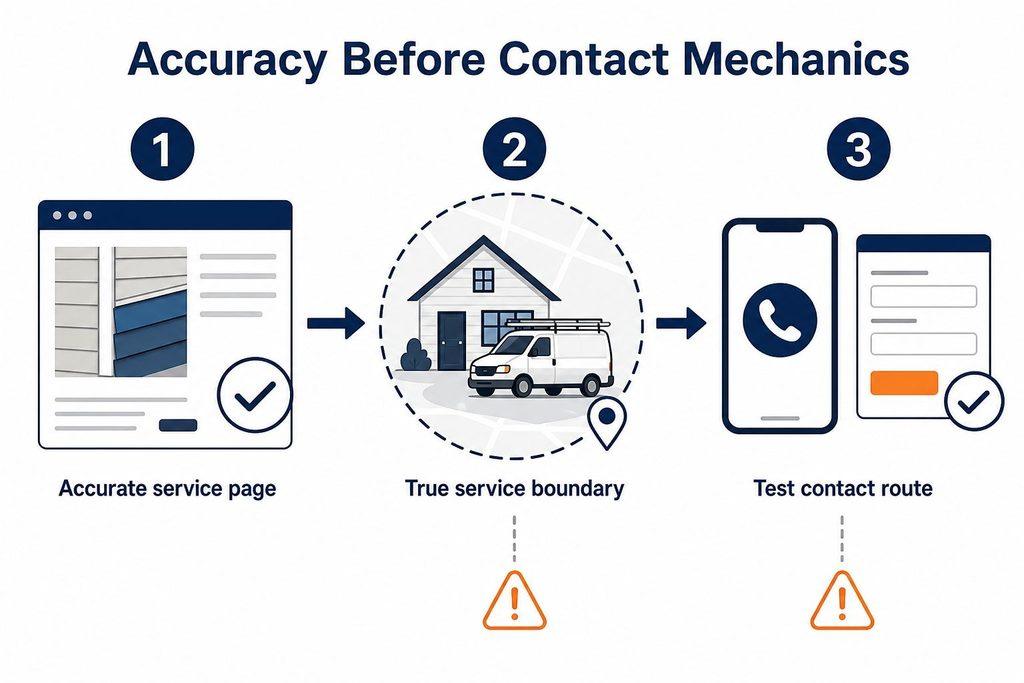
The next two days matter more than the next two months of planning, and the order they happen in is not arbitrary:
- Audit one real repair service page first, because if the highest-traffic page overstates coverage or lists work the crew does not do, every later fix compounds that inaccuracy.
- Verify the service-area boundary in the business profile second, since a wrong radius sends the wrong homeowners to the page that was just corrected.
- Test one phone or form conversion route third, confirming click-to-call works on a real phone and that a form submission reaches someone who will respond same-day.
Each step depends on the one before it holding up. Fixing the conversion route before the page is accurate just routes the wrong homeowners faster. Fixing the service area before the page is corrected sends the right homeowners to a page that still overpromises. Accuracy first, boundary second, and only then the mechanics of contact, is the sequence that keeps the next dollar spent defensible.