

The agency with the most impressive lead count is often the wrong hire. A high volume of form fills means nothing if half of them are homeowners requesting a single-room touch-up when the pipeline gap sits in commercial repaint contracts during the slow months. Lead volume is the metric agencies like to lead with because it is easy to report and hard to dispute in a sales call.
What actually determines whether a painting company fills its calendar in January as reliably as in June is a different question entirely: does the demand-generation partner produce qualified opportunities in the specific mix the business needs, and can that be proven with evidence that exists outside the agency’s own dashboard. That distinction, not the size of any single funnel metric, is what the rest of this evaluation rests on.
Set the Year-Round Project Mix
Before any agency is contacted, the buyer needs a documented brief, not a general wish for “more leads.” Commercial painting projects and residential painting projects behave as separate demand streams with different buying cycles, different decision-makers, and different seasonal patterns, so treating them as one undifferentiated category makes any later comparison meaningless.
The brief should state target project volume by category, the service areas to be covered, and the calendar pattern the business is trying to correct. A residential-heavy contractor that goes quiet every winter has a different problem than a commercial specialist whose bids cluster around a handful of property managers.
Seasonal business downturn and inconsistent lead flow are not the same failure.
One is a predictable calendar gap that can be offset with a counter-seasonal service mix; the other is a structural weakness in how demand gets generated at all. A partner should be judged against whichever of these the brief identifies, not against a generic promise of “year-round growth.” Every proposal that follows gets scored against this written mix, never against its own reported totals.
Separate the Agency Evaluation Dimensions
Comparing proposals side by side only works if each one is scored on the same axes. Four dimensions cover the decision without overlapping: trade specialization and qualified-lead production, channel execution, operating fit and reporting, and commercial terms.
Trade specialization asks whether the agency understands painting-specific buying signals, not general home-services marketing. Channel execution asks whether the proposed tactics can actually reach both a commercial facilities buyer and a residential homeowner. Operating fit and reporting cover who does the work and how performance gets verified. Commercial terms cover price, contract length, and what happens to the accounts if the relationship ends.
A specialist painting marketing agency should be evaluated as a category distinct from a general contractor-marketing shop that adds painting as one of a dozen trades it serves. The qualification logic, seasonal patterns, and channel mix for painting work do not transfer cleanly from roofing or landscaping campaigns, and a shop that treats them as interchangeable will build the wrong campaign structure from day one.
Each of the four dimensions gets tested independently below. A strong score on one does not offset a weak one on another, because a well-run ad account with no ownership protections is still an unacceptable proposal.
Inspect the Demand-Channel Capability
Every channel in a proposal has a distinct job, and a proposal that lists them all without distinguishing their timelines is not a strategy, it is a menu. Local SEO, Google Ads, Local Services Ads, Facebook Ads, content marketing, reputation management, and a conversion-built website each serve different points in the demand curve, and an agency worth hiring should be able to say which ones are built for immediate volume and which ones compound over months.
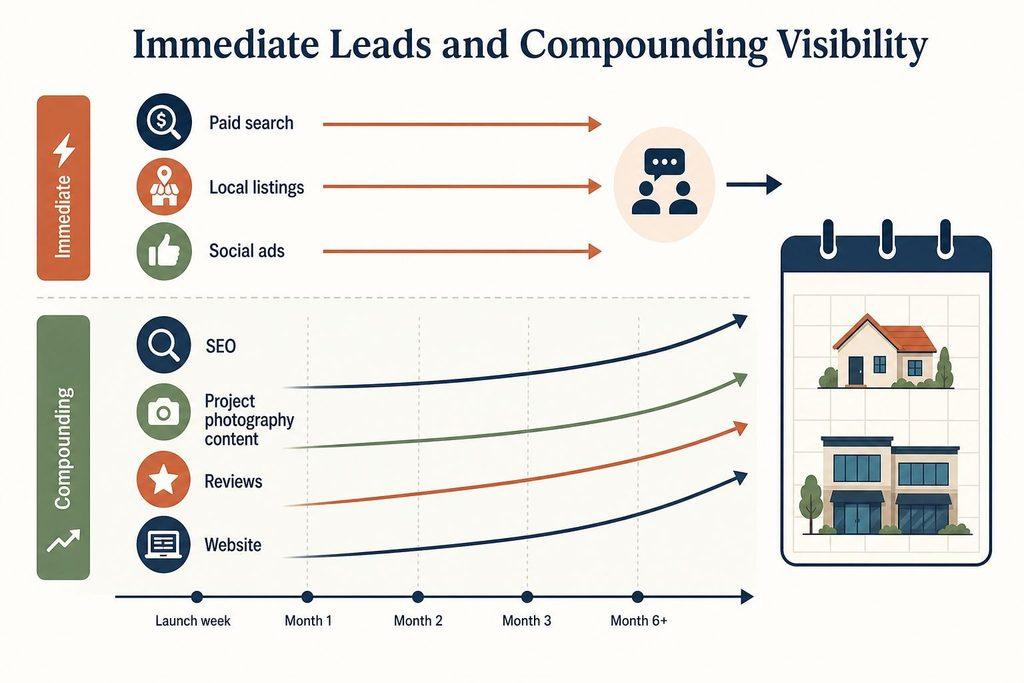
According to an industry guide focused on painter marketing, paid search can start producing leads within one to two weeks, while organic search visibility typically takes three to four months to generate meaningful traffic for terms structured around service plus city, such as interior painting searches in a given market paired with exterior contractor searches in a neighboring one. An agency that presents both channels on the same 30-day timeline is either inexperienced or overselling.
Verify Google Business Profile and LSAs
Local Services Ads carry more qualification weight than most painting contractors realize, because eligibility and ranking inside that product are not bought outright, they are earned through profile signal. Google’s own Local Services Ads documentation specifies that campaigns are structured around business name, service type, and location, which means a competent agency should show a campaign architecture built by service line and geography rather than one generic painter listing running everywhere at once.
That same documentation, echoed across current painter-focused LSA guides, ties ranking and eligibility to review volume and Google Business Profile completeness. The proof to demand here is specific: what did the profile look like before the engagement, what does it look like now, how many reviews were generated in a defined period, and what lead volume moved as a result. An agency that cannot produce that before-and-after sequence is asking for trust it has not earned.
What the Before-and-After Sequence Should Contain
The sequence only counts as proof if it ties four things together in order: the profile’s starting state, the specific actions taken, the review count at a fixed later date, and the lead volume change over that same window. A screenshot of stars with no dates attached is not this.
Review the Visual Site and Project Shots
A painting company sells a visual outcome, and a site without strong project photography is asking prospects to imagine quality rather than see it. The site should separate commercial proof paths from residential ones, since a facilities manager and a homeowner are evaluating entirely different signals when they land on the same domain.
Each path needs a lead-capture mechanism suited to its buyer. A quote request built for a commercial bid cycle looks nothing like a one-field estimate form aimed at a residential prospect, and a proposal that treats the website as a static brochure rather than a conversion instrument tied to both photography and capture mechanics has not addressed half of what the channel needs to do.
Demand Public Source Proof
A private dashboard screenshot proves that a dashboard exists. It does not prove that the numbers on it are accurate, that the leads behind them were qualified, or that the agency, rather than the contractor’s own reputation, produced the result. The same weakness applies to testimonial logos with no attached case detail and to generic before-and-after slides with no client name attached. None of it is public, none of it is source-checkable, and none of it should move a proposal forward on its own.
What should move a proposal forward is a packet: painter-relevant case studies naming a real client or service area, testimonials that can be independently confirmed, and reporting samples that connect spend to a defined chain: qualified leads, conversion rate, cost per qualified lead, booked project volume, and the method used to calculate ROI.
Anything less than that chain is a claim, not evidence.
Trace the Lead-Quality Evidence
Lead-quality evidence answers one question: does the work delivered actually match what the marketing promised to attract. That means checking whether reported leads were tagged by project type, commercial versus residential, at the point of capture, and whether the agency can show the qualification criteria applied before a lead was counted. A raw form-fill count with no filter behind it says nothing about fit.
Trace the Result Attribution
Attribution evidence is different, and it answers whether marketing activity, specifically, moved a lead to a booked job. That requires a defined tracking method, whether call tracking, UTM-tagged forms, or CRM-stage reporting, connecting a specific channel to a specific closed project.
Case examples relevant to commercial painting marketing and residential painting marketing should exist separately, since the sales cycle and proof needed differ between the two. None of this justifies naming a competitor’s reported numbers as a benchmark; the only legitimate comparison is between what a proposal claims and what it can independently document.
Test the Operating Fit
A proposal built around “full-service support” and a rotating team is a different commitment than one built around a named account lead who can be reached directly.
The first promises coverage; the second promises accountability.
An evaluator should ask, plainly, who owns the account day to day, what the communication cadence is, and what happens when a campaign underperforms for two consecutive months.
An operator-tier marketing agency, meaning one where senior practitioners are directly involved rather than delegating everything to junior execution, should describe an escalation path before it is asked for, not produce one only when pressed.
It should also be able to describe how it would adjust the plan if the seasonal mix shifted, say if commercial leads spiked while residential inquiries dropped for two straight months. A vague answer here, heavy on reassurance and light on process, is a signal worth weighting as much as any channel metric.
Compare Price, Scope, and Ownership
Price only means something in relation to what it buys and what remains after the contract ends. A lower monthly fee attached to an account the contractor cannot access if the relationship ends is not actually the cheaper option; it is a deferred cost.
Every proposal comparison should:
- separate management fee from media spend
- list what is actually included at that price
- state, in writing, who owns:
- the Google Business Profile
- ad accounts
- analytics property
- website
- creative files
- tracking data
- and review-management access.
| Comparison Point | What to Require in Writing | Weak Signal |
|---|---|---|
| Fee structure | Management fee and media spend shown separately | Single bundled number with no breakdown |
| Included services | Named channels with defined scope per channel | “Full digital marketing” with no channel detail |
| Reporting cadence | Defined frequency and content of reports | Reports “as needed” or on request only |
| Account ownership | Contractor listed as owner or admin on every asset | Agency retains admin, contractor gets viewer access |
The table only settles the comparison once the ownership row is confirmed against actual account settings, not against a sales representative’s verbal assurance. A contract that is silent on transfer terms should be read as a contract that intends to keep the accounts.
Set the Performance Review Rules
Reporting only has value if the terms for judging it were fixed before the campaign started. Otherwise every result gets explained after the fact in whatever direction favors the agency. The review structure needs to be agreed in writing and checked against actual delivery on a fixed schedule.
The checklist to lock down before signing:
- A written definition of a qualified lead, specific enough to separate a real commercial or residential prospect from a spam submission.
- Source tracking that attributes each lead to a specific channel, not a combined total.
- Cost per qualified lead, not cost per raw inquiry.
- Conversion rate from lead to booked project.
- Booked project volume by category, commercial and residential tracked separately.
- The revenue or ROI calculation method, stated plainly enough to be recalculated independently.
- Reporting frequency, fixed to a calendar, not “regular updates.”
- The specific action triggered if performance falls below an agreed threshold.
Raw inquiry counts, impression totals, and an isolated cost-per-lead figure with no qualification standard behind it cannot substitute for this list. They describe activity, not results.
Score the Finalists Against the Brief
Once proposals are in hand, elimination comes before ranking. Any proposal that cannot document trade-specific fit, produce public proof, commit to transferable assets, or define measurable reporting terms should be removed before scoring begins, regardless of price or presentation quality.
What remains gets ranked against the four dimensions set earlier: trade specialization and qualified leads, channel execution, operating fit and reporting, commercial terms. Each score should sit next to the specific evidence that produced it: a case study, a named contact, a contract clause, so the eventual recommendation can be defended to whoever signs off on the spend, not just remembered by whoever made the call.
Send the Evidence Request
The next step is sending one message, today, to every agency still under consideration. Copy this and send it as-is:
Please send two painter-specific case studies, one commercial and one residential, with client names or verifiable references. Describe your Google Business Profile and LSA setup process, including eligibility steps. Define “qualified lead” and describe how source attribution is reported. Provide management fee and media spend as separate line items. State in writing who owns and can transfer each account asset if the contract ends.
Whatever proposals survive that request are the only ones worth a follow-up call.