

More inquiries do not create more facility management contracts. In most commercial maintenance operations, the opposite is closer to true: a spike in raw lead volume usually means the qualification net widened, not that the pipeline got healthier. A property manager filling out a contact form is not the same event as a facility manager with budget authority and a lapsing contract, and treating them as equivalent is how sales capacity gets spent on accounts that were never going to close.
The gap between the two shows up downstream, in booked estimates that go nowhere and in cost-per-lead numbers that look fine while cost per qualified conversation climbs without anyone noticing. Fixing that gap is not a matter of finding a better channel. It is a matter of separating the decisions that actually govern contract growth from the ones that just generate noise.
Which Lead-Generation Dimensions Determine Commercial Maintenance Growth?
The scope here is bounded on purpose. What follows covers marketing and lead-management activity for commercial property maintenance: how accounts get chosen, how channels get built, how conversations get qualified and handed to sales, and how the results get measured. It does not cover service delivery once a contract is signed, regional market forecasts, or universal conversion benchmarks, because none of those hold steady across portfolios, building types, or service lines.
Inside that boundary, six dimensions do the actual work, and they need to stay separate because conflating them is where most pipeline reviews go wrong.
- Account fit: whether the building, portfolio, or management company matches the service scope and contract value worth pursuing.
- Channel coverage: whether inbound and outbound activity reach the stakeholders who influence or approve maintenance spend.
- Qualification: whether an inquiry or response has been tested against fit and readiness before it consumes sales time.
- Conversion handling: whether qualified conversations move through a defined path to a booked estimate.
- Relationship development: whether early contact is structured to support a multi-year contract, not just a single service call.
- Measurement: whether the team can see which dimension is underperforming, rather than judging the whole system by lead count alone.
A weak channel and a weak qualification process produce the same symptom, a quiet pipeline, but they need different fixes. Improving channel coverage when the real problem is qualification just increases the volume of leads that get dropped downstream. That is the mistake worth naming early, because everything that follows depends on diagnosing which of the six dimensions is actually broken before spending on any of them.
Who Should Commercial Property Maintenance Teams Target First?
Property management firms and facility managers are not the same buyer, even when they sit in the same building.
A property management firm typically controls a portfolio and evaluates a maintenance provider on scalability across multiple sites, standardized reporting, and price consistency across properties it does not occupy.
A facility manager inside a single commercial building or owner-operated asset is closer to the operational risk: equipment failures, tenant complaints, and compliance exposure land on their desk directly, and their evaluation criteria lean toward responsiveness and technical depth over portfolio-wide pricing.
An account worth pursuing is defined by more than industry and location. Building type, asset age and condition, and the complexity of mechanical, life-safety, and cleaning requirements set the service scope. Beyond those baseline attributes, three signals raise or lower the value of pursuing an account:
- Portfolio potential: whether one contract could reasonably expand to sister properties under the same management company.
- Contract timing signals: an approaching renewal, a recent change in ownership, or a shift in on-site management.
- Documented compliance requirements: code exposure or life-safety obligations that create a deadline rather than a preference.
A qualified account carries at least two or three of those signals together. A local inquiry with none of them, a single-property request with no budget authority attached and no timing pressure, is not the same asset even if it lands in the same inbox.
What Makes an Account Worth Pursuing?
The strongest signal is not size, it is condition and timing together: an aging asset entering a renewal window is worth more marketing attention than a large, newly-renovated property with no near-term decision point. Portfolio potential matters almost as much, since a single well-run contract inside a management company’s book is often the fastest route to additional properties without a second sales cycle.
Who Actually Sits on the Buying Committee?
Facility maintenance decisions rarely rest with one person. A property manager may control the shortlist, a regional operations director may control budget, and a facility manager on site may control the day-to-day relationship that determines renewal. Mapping which of those three holds veto power, and which one experiences the pain a provider actually solves, changes how outreach gets written and who receives it first.
How Does Property Intelligence Improve Lead Quality?
Property intelligence, in practical terms, means the observable signals that indicate a building or portfolio is approaching a maintenance decision, not a proprietary data claim and not a guarantee of outcome. The usable signals are consistent across sectors:
- Building attributes such as age, square footage, and system type.
- Portfolio changes including new acquisitions or divestitures.
- Visible service gaps like deferred maintenance or open code violations.
- Ownership or management changes that reset existing vendor relationships.
- Stated procurement activity such as an RFP or a renewal notice.
- Content engagement with material addressing a specific maintenance or compliance question.
None of these signals guarantee a contract. What they do is let a team rank accounts before committing outreach time, and route the highest-signal records into a lead management platform with the context attached rather than as a bare name and address.
That context is what separates prioritization from prediction.
Broader research on facility-management buyer behavior, including IFMA’s facility management pulse research, points to an active and continuously surveyed buyer base rather than a static one, which supports treating intent signals as directional inputs to a qualification process, not as standalone proof of readiness.
Which Inbound Channels Produce Qualified Facility-Service Conversations?
Inbound for commercial maintenance splits into four distinct sources, and each earns its place only if it produces a qualified conversation, not just a form fill.
- Local search visibility for commercial services captures accounts already searching for a provider, but it needs a qualification gate, confirming building type, portfolio size, and decision timing, before it reaches sales.
- Educational content addressing maintenance risk, compliance deadlines, or procurement questions attracts facility managers earlier in their decision process. It earns a qualified meeting when it is paired with a direct follow-up offer, not when it is left to convert on its own.
- Referral-network development, built through subcontractors, brokers, or adjacent service providers, tends to arrive pre-qualified because someone already vouched for fit, though volume is usually lower and slower to build.
- Strategic partnerships and co-selling arrangements, with equipment vendors or specialty trades, extend reach into accounts a maintenance provider would not find through search or content, but they require shared qualification standards to avoid one partner passing along volume the other cannot use.
None of these four channels is sufficient on its own, and the choice among them follows from the target-account profile established earlier. A provider targeting large management companies gets more return from partnerships and search visibility; one focused on single-building facility managers with compliance exposure gets more return from educational content addressing that specific risk.
How Should Outbound Create Booked Estimates Without Wasting Sales Capacity?
Outbound works when three things line up: account research that confirms fit, an operational trigger that makes the timing plausible, and a request for a meeting specific enough that the recipient can evaluate it in ten seconds. Absent any one of those three, outbound becomes volume for its own sake, and volume without fit is exactly the failure mode the account-selection dimension exists to prevent.
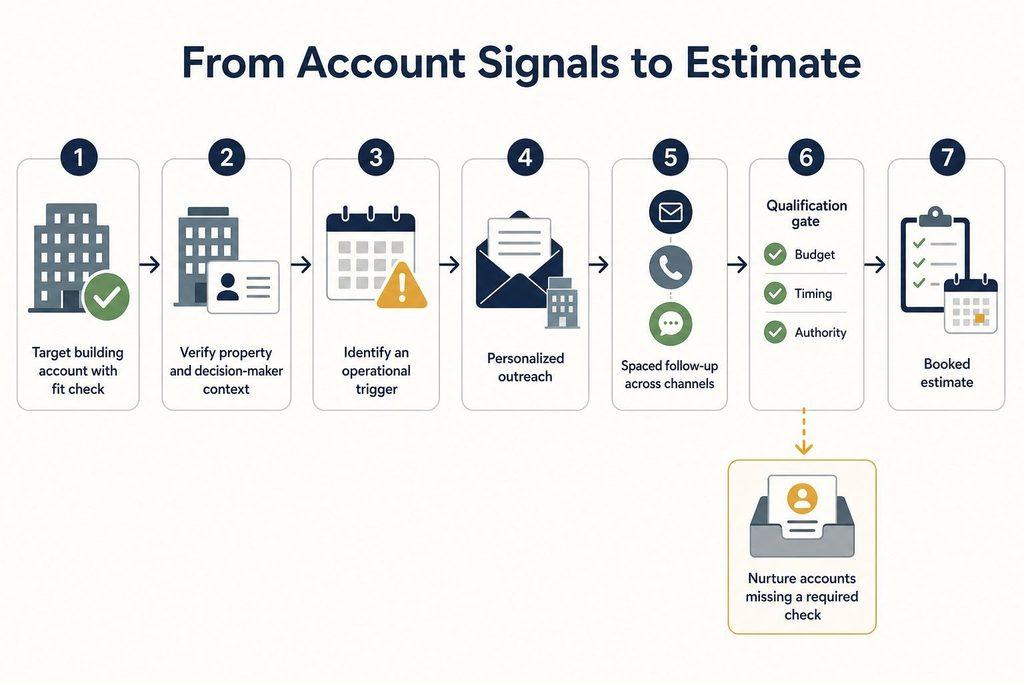
The sequence that keeps outbound accountable to sales capacity runs in a fixed order.
- Select accounts using the fit criteria already established, not a purchased list sorted by geography alone.
- Verify property and stakeholder context, confirming who holds budget authority and what the building’s current maintenance arrangement looks like.
- Form a service-relevant hypothesis, a specific reason this account might need to change providers now.
- Personalize outreach around that hypothesis rather than a generic service description.
- Follow up across approved channels, spacing contact rather than repeating the same message.
- Qualify the conversation against budget, timing, and authority before it is logged as an opportunity.
- Advance only appropriate opportunities to a booked estimate, leaving the rest in nurture rather than forcing a meeting that will not close.
What Makes an Outbound Message Land?
A message built around a real operational trigger, an expiring warranty, a recent violation notice, a management change, reads as informed rather than opportunistic. A message with no trigger reads as a template, regardless of how well it is personalized with a name and building address.
What Happens Between a Qualified Call and a Booked Estimate?
The handoff needs a defined threshold: confirmed budget range, confirmed decision timeline, and confirmed access to the site or documentation an estimate requires. A call that is warm but missing one of those three should stay with marketing or an inside qualifier, not consume a technical estimator’s time.
Where Do Lead Management Platforms and Automation Belong in the Process?
A lead management platform is infrastructure, not a strategy. Its job is to:
- capture source data;
- enrich account and contact records;
- route qualified leads to the right person;
- prompt follow-up on a schedule;
- hold consistent qualification-status definitions;
- manage the handoff to a booked estimate; and
- preserve attribution back to the channel that produced the lead.
None of that improves account fit or channel selection; it only prevents good work from being lost or duplicated.
Failure shows up in familiar places: duplicate records that split the history of a single account across two entries, follow-up tasks with no owner, lifecycle stages that mean something different to marketing than they do to sales, and automation sequences that fire regardless of whether a human has actually reviewed the account.
Automation can support the sequence described above, but it does not raise conversion rates by any fixed amount, and claiming otherwise misrepresents what a workflow tool does. Its value is in making sure a qualified conversation never sits untouched because no one owned the next step.
How Do Early Conversations Become Long-Term Facility Management Contracts?
Before an estimate is scheduled, the team needs a clear answer to what the building actually requires, not just what the prospect initially described, since scope gaps discovered mid-estimate slow the process and damage credibility. Pricing discussions expose fit quickly: a prospect focused entirely on unit cost with no interest in service consistency or reporting is a different account than one asking about response times and multi-site standardization.
A pilot or a narrow initial service agreement can function as a proof point for expansion, particularly with a management company controlling other properties, but only if the account communication during that pilot documents outcomes the prospect can point to internally when justifying a larger contract.
Lead generation ends at a qualified meeting. Sales qualification ends at a signed agreement. Contract delivery is where retention and customer lifetime value actually get built, and confusing the three stages is how marketing gets credited or blamed for outcomes it does not control.
Retention-focused communication after signing, regular reporting, proactive flagging of emerging issues, is what turns a single contract into portfolio expansion within the same management company.
Which Measures Show Whether Multi-Channel Marketing Is Scaling?
A measurement chain that only tracks leads misses where the system actually breaks.
The full sequence runs from target accounts reached, to engaged accounts, to qualified conversations, to qualified meetings, to booked estimates, to opportunities, to signed contracts, to retained accounts, and finally to expansion within existing portfolios. Each step has its own drop-off, and the step with the worst drop-off is where attention belongs, not the top of the funnel by default.
Cost per qualified conversation matters more than cost per lead, because cost per lead rewards whatever channel produces the cheapest form fill, regardless of whether that lead ever reaches a real conversation.
A channel with a high cost per lead but a low cost per qualified conversation is outperforming one that looks cheaper on the surface.
Reviewing channel performance without reviewing account quality hides the real problem.
A channel can hit its lead targets while account fit declines in the background, and that decline will not show up until booked estimates or signed contracts fall off months later. Neither figure should be reviewed alone.
What Should the Team Do First to Build a Stronger Contract Pipeline?
Choosing one priority account segment, defined by building type, portfolio potential, and a documented buying signal, and matching it to a single operating action is the fastest way to convert this into work rather than a framework left on a shelf. Trying to fix account fit, channel coverage, and measurement simultaneously spreads effort too thin to see which change actually moved the pipeline.
The next move is small enough to finish today: pull the current account list, mark each record against building type, portfolio potential, and a documented timing signal, and set aside the ones missing two of those three. Everything else in the pipeline improves faster once that shorter, better-matched list is the one being worked.
The table below is a starting point, not a full diagnostic. It maps the situation a pipeline owner is most likely facing today to the first concrete move.
| Situation | First Action |
|---|---|
| Unclear account fit across the current target list | Rebuild the account list against building type, portfolio potential, and a confirmed timing signal before adding any new channel spend |
| Weak buyer-intent context on inbound leads | Add a qualification step that captures budget authority and timing before a lead reaches sales |
| Too few qualified conversations despite steady lead volume | Audit whether outreach messages reference a real operational trigger or read as generic templates |
| Follow-up on warm leads is inconsistent or unowned | Assign explicit ownership for every qualified lead inside the lead management platform before adding more sources |
| Channel spend and channel results cannot be tied together | Instrument cost per qualified conversation by channel before increasing budget on any one of them |