
What would it cost a practice to keep two more principals fully billable for a year, and what would it take in new commissions to justify that cost without discounting fees to win them? Most studio directors have a rough answer for the first half of that question. Very few can answer the second with any confidence, because the pipeline that is supposed to deliver those commissions was never built to be measured.
That gap between design reputation and demand certainty is the actual problem, not lead volume.
Diagnose the Premium-Lead Problem
A referral-led pipeline and a functioning lead generation system are not the same thing wearing different clothes. Referrals arrive when a past client happens to talk to the right person at the right time. A system produces enquiries on a schedule the practice can plan around, from people who already understand roughly what the work costs and why the studio is suited to it.
The difference shows up first in cash flow forecasting and second in the type of enquiry that lands: fee-sensitive, portfolio-mismatched, or asking for free concept work before any commitment exists.
Understand the Shortlist Process
Architectural commissions are bought slowly and by committee. A single project can move through months of internal discussion, budget approval, and stakeholder sign-off before a studio is shortlisted, let alone appointed. During that period the practice is not present in the room.
What stands in for it is whatever material the prospective client can find and share internally: a website, a case study, a set of photographs, a reputation someone half-remembers from a conference panel. If that material does not answer the questions a finance director or a board member will ask, the studio does not make the shortlist, regardless of design quality.
Set a More Useful Goal
Fee scrutiny compounds this. A prospective client comparing three practices on a spreadsheet will discount anyone whose value is unclear, and undiscounted architectural fees are hard to defend against undifferentiated marketing.
The goal worth setting is narrower than “more leads.” It is becoming the obvious, low-risk choice for a specific type of client before that client has spoken to anyone. Building that kind of visibility is what serious architecture marketing actually does, as distinct from generating enquiry volume that has to be filtered by hand later.
Assess the Current Position
The AIA’s own course on building a firm marketing plan framework is built around exactly this discipline: assess where the practice currently sits in its market before setting any goal, rather than assuming more activity will fix an unclear position.
Map the Buying Committee
A marketing plan aimed at “clients” in general will underperform one aimed at a defined buying committee, because architectural procurement rarely involves a single decision-maker acting alone.
Trace Technical Buying Requirements
Large or technically complex commissions are usually reviewed by more than one party with more than one concern. A short mapping exercise, done once and revisited quarterly, keeps this from becoming guesswork:
- List the two or three project types the practice wants more of, and the client type that commissions them.
- Name the likely decision-maker, influencer, and technical reviewer for each, separately.
- Note what each of those roles needs to see before recommending the practice: budget precedent, delivery risk evidence, technical compliance, design outcome.
- Mark where in that journey the practice currently has no proof asset at all.
- Set a minimum budget range below which the fit is poor regardless of design interest.
Scale the System for a Small Studio
A small studio does not need three buyer profiles running in parallel. One well-evidenced segment, chosen deliberately, outperforms a broad campaign built to look like a larger competitor’s. The qualification routine can be as short as three questions asked at first contact: project type, decision timeline, and who else is involved in choosing the architect.
Define a Defensible Position
Positioning is often treated as a visual exercise: a new logo, a tighter photography style, a rewritten “about” page. None of that is wrong, but none of it is positioning either. A defensible position is a promise about risk reduction: this practice, for this type of client, with this problem, is the lower-risk choice. Everything visual should express that promise, not substitute for it.
Specify the Ideal Project
The specification has to be concrete enough to exclude work, not just describe it. That means naming a project type, the client problem it solves, the technical or delivery strength the practice brings to it, and, just as importantly, what the practice will say no to. A studio that claims to do everything from single-family houses to hospital campuses is not positioned; it is available. Exclusion criteria are what make the remaining claim believable.
Build Proof Around the Promise
Once the claim is specified, every proof asset has a job: to make that specific claim credible to a specific buyer. A sector-specific case study, a client testimonial, project photography, plans, and process diagrams should each answer a question the buying committee would otherwise have to ask out loud.
A finished building photographed well is evidence of design outcome. It is not, on its own, evidence of budget discipline, programme management, or stakeholder handling, and those are frequently what wins the commission.
Show How the Practice Handles Risk
The AIA’s own guidance on levelling up firm marketing puts this plainly: material should educate entertain or inform the audience, not simply display recent work. A process diagram that shows how a planning objection was resolved does that. A gallery of finished interiors, however handsome, does not.
Thought leadership belongs in this same test. An article or talk only earns its place if it clarifies how the practice thinks about a problem the target client actually has.
Turn the Website Into a Sales System
An attractive portfolio site and a functioning sales asset can look identical and perform completely differently. The first collects admiration. The second moves a stakeholder toward a qualified conversation, and that requires deliberate structure rather than good photography alone.
A short audit is enough to tell the difference:
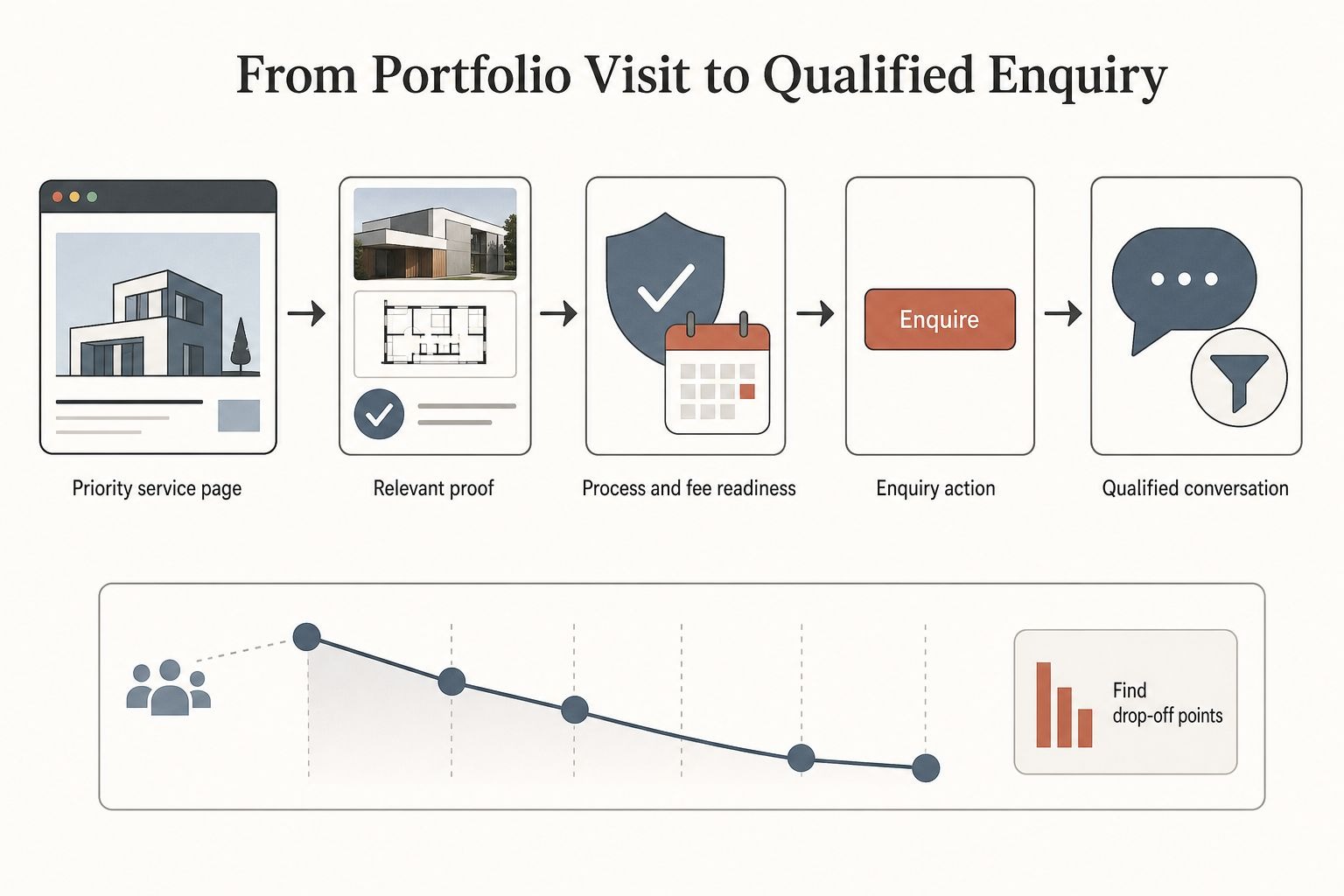
- Service pages built around priority project types, not a single generic “services” page covering everything the practice has ever done.
- A visible path from each service page to a matching case study, so a visitor never has to search for relevance.
- Process and fee-readiness signals stated early, including how proposals work and what typically happens before a fee is discussed.
- One clear, low-friction enquiry action per page, not three competing calls to action.
- Search visibility built around buyer questions, not just firm name and project type keywords.
- Analytics that show where visitors stop, not just how many arrive.
Two numbers matter here and they are not the same thing: conversion rate, meaning how many visitors take the enquiry action, and qualified enquiry rate, meaning how many of those enquiries match the defined ideal project. A site can improve the first while getting worse at the second.
Select Channels by Buyer Intent
Channel choice should follow directly from the buyer map and the proof gap identified earlier, not from a generic list of things architecture firms are told to do. A studio that has not yet built sector-specific case studies has no business running a paid social campaign; there is nothing credible for that traffic to land on.
Search visibility, published case studies, and selective thought leadership work as awareness mechanisms. They put the practice in front of people early, often before those people know they are forming a shortlist. Social media, used sparingly, extends that same reach without doing much to move a considered buyer toward a proposal request. None of these produce a qualified conversation by themselves.
Use Direct Contact for Qualified Conversations
Referral cultivation and personalised outbound contact do a different job. A direct message to a known contact at the right stage of a known project has a far higher chance of producing a real conversation than any volume of passive content, precisely because it is targeted rather than broadcast.
Where email follow-up plays a role, it should stay permission-aware and genuinely useful rather than frequent, and any list-building or nurture sequence needs to sit inside GDPR and CAN-SPAM Act obligations rather than treat compliance as an afterthought.
Convert Bids, Awards, and Specs Into Proof
A bid document, an award citation, or a piece of specification detail earns attention only when it is translated into terms the next prospective client actually evaluates on. Left as-is, they are internal records. Reworked, they answer specific procurement questions.
A bid narrative that shows how the practice managed a comparable risk, a difficult site, a compressed programme, a contested planning process, is more persuasive than a narrative that only restates design intent. Risk control is what a client with budget authority is actually worried about.
Match the Proof to the Reader
An award is useful context, evidence that peers or juries rated the work, but it answers “is this practice competent” rather than “is this practice right for my project.” Treating it as a substitute for fit undermines the very specificity the earlier positioning work established.
Specification and technical documentation speak to a different reader entirely: a technical buyer checking for compliance depth, coordination discipline, or delivery method experience. That material belongs linked to a relevant case study or a direct route to a conversation, not left as a standalone download with no next step attached.
Apply American Institute of Architects Guidance
The American Institute of Architects is a professional-practice reference, not a source of ready-made leads, and treating it that way avoids a common misreading of what association material is for. Its Best Practices resource includes guidance specifically on architectural marketing planning, moving a practice from plan to actual execution, which is a useful structure to sit alongside the positioning and proof work already described rather than a replacement for it.
Where the AIA’s code of ethics is relevant, it belongs here, in this professional-guidance context, shaping how claims are made and how client relationships are represented rather than functioning as a marketing hook.
Credibility built this way is harder to dispute than an awards list: clear claims, evidence that matches those claims, and a route into a qualifying conversation that respects the buyer’s own process rather than pressuring it.
Measure Quality and Audit One Enquiry
Marketing spend earns scrutiny the same way a construction budget does: as a system with observable stages, not a single number at the end:
- Source quality
- lead qualification rate
- meeting-to-proposal rate
- proposal win rate
- average fee per commission
- sales-cycle length
- website conversion rate
- and return on investment
are each measurable, and each one points to a different fix when it underperforms.
Trace One Recent Qualified Enquiry
One action is worth taking today, before any of the above gets formalised into a dashboard: pull one recent qualified enquiry and trace it. Where did it originate. What proof asset, page, or conversation prompted the contact. What doubt remained unresolved at handoff. Where, if anywhere, the internal handoff between marketing contact and studio response broke down.
That single trace usually surfaces the same pattern a full audit would, just faster and without the dashboard.
| Situation | Next Measurement or Fix |
|---|---|
| Enquiries arrive but rarely match the ideal project | Revisit positioning specificity and exclusion criteria before adding channels |
| Case studies get little engagement on the site | Rework proof assets to answer buyer questions, not display finished work |
| Proposals are shortlisted but rarely won | Audit fee-readiness cues and bid narratives for risk-control evidence |
| Sales cycles run long with no clear stage | Map the buying committee and identify where a proof gap stalls momentum |