

Can the provider standing in front of a proposal actually prove that its work moved a mower crew or a patio-build company into the map pack, or is the pitch built on screenshots that could belong to any business in any city? Most owners cannot answer that with confidence, and that is not a knock on them.
Landscaping SEO offers are written to sound identical: more calls, better rankings, top of the map. The words do the same job whether the agency behind them runs a two-person shop or a national reseller of outsourced reports. What separates a defensible hire from an expensive guess is not the pitch. It is whether the provider will submit to the same fixed set of comparison points as every competitor bidding for the account, and whether those points can be checked against something other than its own dashboard.
What Should A Landscaping SEO Provider Be Judged On?
Search engine optimization for a lawn care or patio-construction business is a choice of operating partner, not a lottery ticket for page one. Nobody, including Google itself, can promise a ranking position. What can be promised, and checked, is a process: who does the work, how service areas get defined, what gets measured, and who owns the assets when the contract ends.
That process holds still whether the provider sells a flat monthly package, bills hourly for a defined scope, or runs an open-ended retainer. Pricing structure is a commercial detail. The dimensions underneath it do not change:
- Relevant experience: has the provider worked lawn care, hardscape, or design-build accounts specifically, not general home services lumped together?
- Local-search plan: is there a written approach to Google Business Profile, service-area pages, and citation accuracy?
- Service-area accuracy: does the plan target the towns and radius the business actually serves, not a metro-wide net?
- Measurement: are ranking, traffic, and lead data reported separately, with a defined conversion event?
- Transparency and communication: does the provider explain what it changed and why, in plain language?
- Asset ownership: does the business keep the Google Business Profile, analytics account, and website access if it leaves?
- Commercial terms: what is the cancellation notice, and what happens to the work already paid for?
A firm offering landscaping seo services should be able to walk through every one of those seven points without redirecting the conversation back to a ranking promise. If a sales call cannot get through the list, the proposal that follows is unlikely to either.
The scorecard does not rank providers by price or by size. It ranks them by whether the answers are specific enough to check later, against real data, rather than specific enough to sound reassuring on a call.
Why Does Local SEO Need To Lead The Comparison?
A service-area business earns most of its qualified calls from people searching while already deciding who to hire this week, not from broad brand awareness. That puts local search at the center of the comparison, without making it the only channel worth funding. Referrals, repeat customers, and paid ads still matter, but the map pack and the local organic results are where a homeowner comparing three lawn crews or two patio builders actually makes the call.
Google has been explicit that local ranking rests on relevance, distance, and prominence working together. A provider chasing one of the three while ignoring the other two is not offering a shortcut, it is offering an incomplete plan.
Map pack optimization, in other words, is a connected system. A Google Business Profile that accurately describes the services offered, a website that reinforces the same service area and terms, and a reputation signal built from real reviews and consistent listings all have to move together. None of those work in isolation.
Why Does Specialization Matter For Lawn Care And Patio Construction?
A mowing and maintenance account wants volume: recurring, moderate-value jobs across a wide residential footprint. A patio-construction or design-build account wants the opposite: fewer, larger jobs, often requiring a longer sales cycle and a portfolio-driven website. A provider treating both business types with the same keyword list and the same page structure is not being efficient, it is ignoring the difference in what a qualified lead looks like for each one.
What Can Google Maps Work Influence?
Google Business Profile completeness, accurate service categories, review volume and recency, and citation consistency are all within a provider’s control, along with how tightly the profile’s stated service area matches the address radius Google actually associates with the business. Distance from the searcher is not. No ethical provider can guarantee a map position, because no provider can move a business closer to a searcher’s front door.
How Should A Google Business Profile And Service Area Be Evaluated?
A Google Business Profile review is where inflated promises get separated from actual craft, because the profile is checkable in minutes by anyone with the login. The evaluation should confirm a handful of specifics before anything else:
- Category accuracy: primary and secondary categories match the real services, not the highest-competition category available.
- Service-area boundaries: the listed radius reflects where crews actually travel, not an aspirational metro-wide claim.
- Photos and updates: recent job photos and posts reflect current work, where the business type makes that practical.
- Access and ownership: the business, not the agency alone, holds administrative access to the profile.
- Monitoring approach: a documented method for checking map-pack position over time, not a single screenshot taken once.
A provider unwilling to explain, in plain language, how it avoids drawing calls from outside the real service radius or for services the crew does not perform, is optimizing for volume rather than fit. A profile improvement plan is not the same claim as a map-ranking promise, and the two should never be presented as interchangeable.
Can The Provider Match Keywords And Pages To The Right Jobs?
Keyword and on-page work should read as two separate plans stitched together, one for lawn care demand and one for patio-construction or design-build demand, rather than a single generic list aimed at “landscaping near me.”
Before committing, an evaluator can reasonably request an anonymized sample showing which keywords map to which page, along with the proposed priority order for service pages and location pages. That sample should reveal whether the provider understands that a maintenance search and a patio-build search carry different intent, different page structures, and different calls to action. Title tags, on-page copy, and the path from a page to an estimate request all need to reflect that difference.
A provider whose plan is built around broad, high-volume traffic terms is a weaker fit for a business trying to narrow its project mix toward higher-value patio or hardscape work. Traffic without qualification is a cost, not a result.
What Should A Technical Audit Actually Reveal?
A technical audit worth paying for produces a prioritized list of findings and fixes, not a glossary of terms the business owner has to look up. At minimum, it should address crawlability, mobile usability, page speed, indexing gaps, duplicate or thin service pages, and the reliability of call tracking and form submissions, since a broken form silently erases leads no ranking report will ever show.
Each finding should connect to either search visibility or lead measurement, explicitly. A slow page affects rankings and abandonment. A duplicate service page splits authority between two URLs competing with each other. A miscounted form submission hides real demand.
The provider should also state what it will fix directly, what requires business or developer approval, and how it will verify the fix worked once deployed. An audit that lists problems without owners or verification steps is a sales document wearing a technical costume.
How Will Citation Building And Review Management Protect Local Trust?
Citation work and review management sit closer together than most proposals admit, because both feed the same prominence signal Google uses to rank a business locally. The baseline is consistency: name, address, and phone number matching exactly across the major directories and listing sources a business appears on.
A 2026 Map Pack guide from a local-search marketing resource recommends correcting meaningful citation and directory inconsistencies as a standard part of local SEO work. That correction should be visible in a before-and-after audit rather than described only in a sales deck.
Beyond citations, a review process should be compliant. That means no purchased reviews, no gating negative feedback away from the public platform, and no incentive structure that violates platform terms.
Review responses matter almost as much as review volume. A provider drafting responses in the business’s actual voice, addressing specifics rather than pasting a generic thank-you, is doing the work correctly. Review score should be tracked as a signal to monitor, not sold as a guaranteed outcome, and any provider promising a specific star rating within a set window is making a claim it cannot control.
Which Reports, Terms, And Proof Make An SEO Service Accountable?
Proof, before signature, should include anonymized reporting screenshots from a prior or current account, a sample of what a first 90-day plan looks like, and any case studies or testimonials specific to home-service or landscaping clients. Certifications and general industry reputation add context but should never substitute for the actual work sample.
Reporting itself needs to separate distinct metrics rather than blending them into one vague “growth” number. That means:
- local ranking position,
- organic traffic,
- click-through rate,
- conversion rate,
- calls and form submissions,
- citation consistency,
- and review score, tracked as separate lines,
- plus, where the business can supply it, which leads turned into booked jobs.
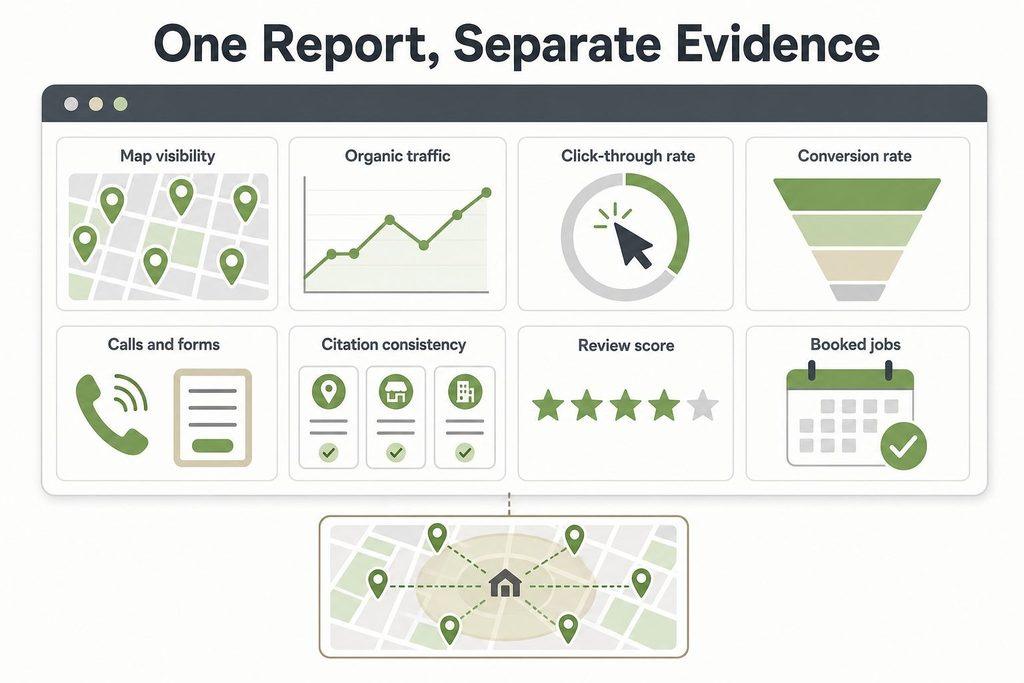
A 2026 Map Pack guide recommends checking visibility from multiple map points, tracked weekly or monthly, rather than relying on a single desktop search from the office, since map position shifts by physical location.
Contract terms deserve the same scrutiny as the marketing plan: who owns the accounts, what access looks like after cancellation, the notice period required, the defined scope, and how the plan adjusts for seasonal demand swings in mowing or hardscape work. Six months is a reasonable point to review accountable progress. It is not a deadline by which results are owed.
Which Landscaping SEO Service Fits The Situation?
The right provider is the one that makes the local, service-specific work, the ownership terms, the risks, and the measurement plan visible before money changes hands. That verdict holds across most lawn care and patio-construction accounts.
It flips only when the business’s own service mix shifts toward a narrower or broader project type, when internal marketing capacity changes what needs outsourcing, or when the existing website’s condition demands a heavier technical rebuild than a standard local-search engagement covers.
Score every prospective provider against these written dimensions this week, and ask each one for a plain-language explanation of what it would prioritize in the first 90 days before signing anything.
| Situation | Right Provider Profile |
|---|---|
| Google Business Profile is thin or incomplete | A specialist focused on GBP accuracy, categories, and service-area setup before broader campaign work |
| Listings show inconsistent name, address, or phone details | A provider with a documented citation-cleanup process and before-and-after proof |
| Patio or hardscape leads are low-quality or low-value | A provider that separates keyword and page strategy by service type, not one generic plan |
| The website has speed, indexing, or tracking problems | A provider offering a prioritized technical audit tied to visibility and lead measurement |
| Rankings exist but growth has stalled | A provider offering full metric separation and multi-point map tracking, not a single traffic number |