

The landscaping business that spends the most on marketing is rarely the one that grows the fastest. What separates a company with a full crew calendar from one burning cash on leads it cannot service is not budget size but sequence: which decisions get made first, which get tested in bounded amounts, and which get postponed until the operation can actually absorb the demand they create.
Most operators reverse that order. They fund advertising before their website can convert a visitor into an estimate request, and they promote seasonal services their crews cannot deliver on schedule. The result is a familiar complaint, plenty of inquiries and thin profit, because the marketing system was never built to match capacity.
A landscaping business that treats demand generation as a sequence of five decisions, rather than a single spending line, tends to avoid that trap.
Which Five Marketing Decisions Create Year-Round Landscaping Demand?
Everything below concerns generating demand for services a landscaping business can actually fulfill on schedule. It does not cover pricing methodology or landscape design principles, both of which belong to a different conversation and are addressed only briefly, later, as optional context.
The first decision is brand positioning and customer segmentation. A business serving residential landscaping leads and one pursuing commercial landscaping contracts are not necessarily run differently in terms of crew skill, but they are marketed differently: the buyer, the decision timeline, and the proof points differ enough that a single generic message tends to under-serve both.
Segmentation is the decision to say plainly who the business serves and why, before spending anything on visibility.
The second decision is local discoverability: whether a nearby homeowner or property manager can actually find the business when they search for the service they need. The third is demand capture, the mechanical path from someone finding the business to someone requesting an estimate.
- Trust and conversion. The fourth decision covers the evidence, reviews, photos, referrals, that turns an inquiry into a booked job rather than a comparison-shopping dead end.
- Retention-led seasonal expansion. The fifth decision uses each completed job as the starting point for the next one, carrying a spring customer into fall and winter conversations.
That fifth decision is where the seasonal throughline matters most. A spring lawn care customer is a plausible fall cleanup customer. A fall cleanup customer is a plausible candidate for a winter services conversation, which in turn opens the door to snow removal promotion where climate supports it, and to holiday lighting services in the weeks before that.
None of this works, though, if the first four decisions were skipped. Coordinated landscaping marketing exists to connect those five decisions into one calendar rather than five disconnected campaigns competing for the same budget.
Can a Landscaping Website Turn Nearby Search Intent into Estimates?
Local search traffic is only useful if it lands somewhere that converts. A visitor searching for a specific service in a specific area is close to ready to request an estimate; what happens on the page they land on decides whether that intent survives contact with the business.
What Makes a Website Convert a Visitor into an Estimate Request
A landscaping website earns that conversion through a small set of concrete elements, not general polish:
- Service and service-area pages built separately. A page for spring cleanup and a page for the town or district it serves outperform one blended “our services” page, because each answers a narrower, more specific search.
- An estimate path that takes under a minute to start. A form, a call button, or both, positioned above the point where most visitors stop scrolling, with no unnecessary fields standing between interest and submission.
Photos of completed work, arranged by service type, do more to confirm fit than another paragraph of description. Consistent business details, name, phone number, and address matching exactly across the website, directories, and Google Business Profile, remove a source of friction the visitor never consciously notices but the search engine does.
What Local Visibility Actually Requires
A local landscaping SEO guide identifies several leading factors in local ranking: Google Business Profile optimization, review quantity and quality, on-page content built around location and service keywords, consistent business listings, and photos of finished work. None of that guarantees a top position, and the evidence behind it comes from a single market rather than a universal study.
The pattern, though, is consistent enough to act on. Search engine optimization for a landscaping business is really about matching the words a nearby customer would type, “gutter cleanup near me,” “spring aeration [town]”, with a page built to answer that exact query. Website traffic that arrives this way tends to convert into estimate requests at a higher rate than broad, untargeted visits, because the visitor already believes the business is close enough and capable enough before they click.
Which Digital Channels Deserve Budget After Local Visibility Is Sound?
Once the website converts and local listings are accurate, the next question is where additional budget goes. That question splits cleanly into demand a business earns and demand it buys, and the two behave differently enough to warrant separate handling.
What Owned and Earned Demand Can Do Without Ongoing Spend
Content built around actual customer questions, when to schedule aeration, how a fall cleanup differs from a spring one, what a winter services contract includes, tends to compound over time rather than expire the day spending stops. It supports the same local search visibility discussed earlier and gives the sales conversation something to point to.
Email marketing to an existing list of past customers and estimate requesters costs little beyond the platform fee and reaches people who already know the business. That makes it one of the more efficient ways to announce a seasonal service before a competitor’s ad ever reaches that same inbox. Neither channel replaces local visibility work; both depend on it, since a strong article or a lifecycle email sequence still relies on the same site infrastructure to convert.
What Paid Channels Demand in Return for Their Cost
Pay-per-click advertising through Google Ads or Facebook Ads is the one channel that can be turned on and off deliberately, which makes it well suited to bounded tests rather than open-ended spending. It should be geo-targeted tightly to the actual service radius, not a metro area the crew cannot reach economically, and it should point to a service-specific landing page rather than a general homepage.
A test budget, set in advance with a stop point, and limited to services the business can currently staff, keeps a paid experiment from becoming a standing cost nobody revisits. Advertising a service the crew cannot deliver on schedule produces the worst possible outcome: real spend, real inquiries, and no capacity to convert them into satisfied, repeat customers.
How Do Reviews and Referrals Improve Lead Quality Without Discounting?
Trust signals do more to raise lead quality than any discount, because they answer the buyer’s real question, whether this business will actually show up and do the job well, before the estimate call even happens. A stronger flow of accurate reviews and warm customer referrals tends to shorten the sales conversation and reduce price objections, without touching the price itself.
Reputation work benefits from being treated as a repeatable workflow rather than an occasional ask:
- Choose the moment. Request a review right after a completed job the customer visibly liked, not weeks later when the memory has faded.
- Ask for accuracy, not enthusiasm. A specific, honest review (what was done, how it went) reads as more credible to the next visitor than a generic five-star comment.
- Route complaints into service recovery first. An unhappy customer asked for a review before the issue is resolved produces the review the business least wants public.
- Document referrals when they happen. Note who sent the lead and what job resulted, so the pattern becomes visible over time rather than anecdotal.
- Acknowledge the source appropriately. A note or a modest gesture toward a customer who sent new business costs little and reinforces the exact behavior worth repeating.
Handled this way, review quality and customer referrals become part of brand positioning rather than an afterthought bolted onto customer service.
What Turns Landscaping Leads into Profitable Booked Work?
A rising number of inquiries is not the same as a rising number of profitable jobs, and treating them as interchangeable is where budget decisions go wrong. The gap between the two is usually explainable, and it is usually one of a small number of leaks.
- Unclear service fit sends inquiries to a business that cannot actually do the work, wasting time on both sides.
- Slow follow-up on estimate requests loses jobs to whichever competitor called back first, regardless of quality.
- An unconfirmed service radius produces travel costs that erase the margin on the job.
- No source capture means nobody can tell which channel is working, so the same underperforming spend continues by default.
- And no offer after a completed job leaves a satisfied customer with no reason to come back for the next season.
CRM software closes most of these gaps by forcing five things to be recorded for every inquiry:
- the source it came from
- the service requested
- the estimate status
- the close outcome
- the follow-up date
- Once that record exists, conversion rate and client retention stop being impressions and become numbers that say plainly whether generating more leads is actually the right next move, or whether the business needs to fix what happens after the phone rings first.
How Should Seasonal Promotions Convert One-Time Jobs into Recurring Revenue?
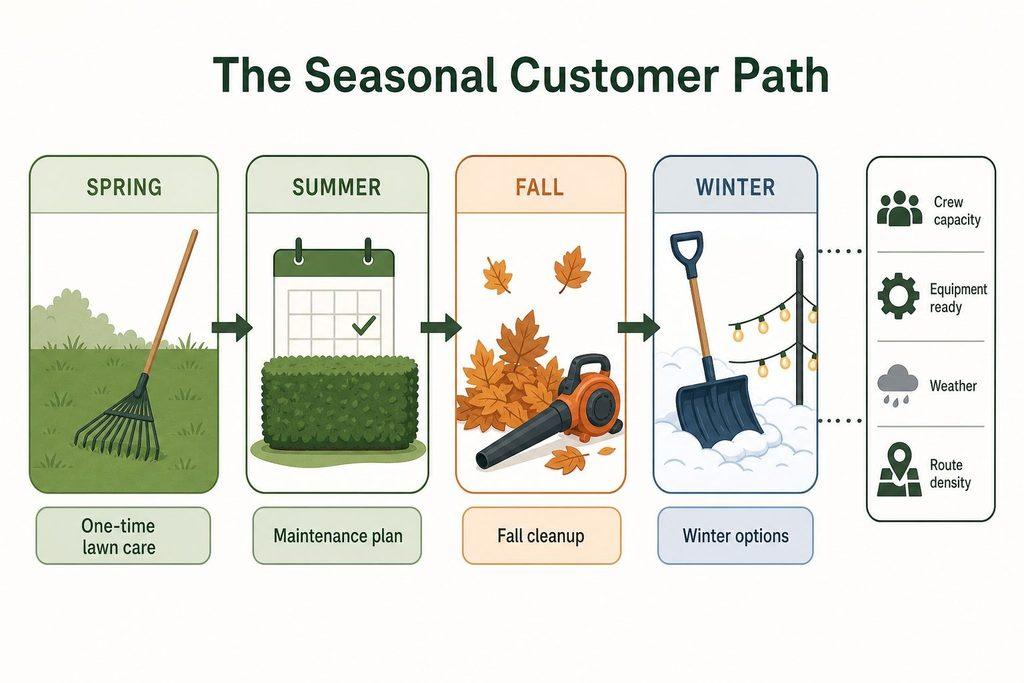
A service calendar, not a single seasonal push, is what turns one job into a recurring relationship. Spring lawn care is the natural entry point for a maintenance-plan offer, since the customer has just seen the property looking better and is primed to want that maintained rather than repeated from scratch.
A fall cleanup, similarly, is the right moment to raise winter services, while the property and the relationship are both fresh in the customer’s mind. Where climate allows, winter services opens directly into snow removal promotion, and the weeks before that into holiday lighting services, each conversation building on trust established by the last job.
Upselling works best as a fit-and-timing decision rather than something offered to every customer by default.
A maintenance plan pitched to someone who only wanted a one-time cleanup damages the relationship it was meant to extend.
Before any seasonal promotion goes out, it is worth checking crew availability, equipment readiness, likely weather disruption, and whether the added route actually pencils out once travel time and job density are accounted for. A promotion that oversells a season the operation cannot service costs more in strained crews and refunded deposits than it earns in new revenue.
Which Numbers Show Whether Marketing Spend Is Scaling Safely?
Measurement is what keeps every decision above from becoming a guess. Attribution, tracking which channel a lead actually came from, is the starting point, because website traffic and lead volume by source mean little without it.
From there, customer acquisition cost and conversion rate together show whether a channel is efficient, while lead quality shows whether the leads it produces are ones the crew can actually close and service well.
A 2025 landscaping benchmark guide recommends tracking six core figures: website sessions, lead volume by source, cost per lead by channel, quote close rate, average job value, and return on ad spend.
Seasonal revenue and overall return on investment then tell the larger story, whether the spend across a full year, not just a single campaign, produced growth the business can absorb. None of these numbers proves a universal target worth copying; they exist to guide the next decision, not to certify the last one.
What Is the Next Marketing Decision to Make Today?
Before adding spend anywhere, identify the single constraint doing the most damage right now, confirm the crew can actually fulfill the service being promoted around it, and attach one metric to that decision so its effect can be measured rather than assumed.
Pick the row that matches the constraint actually slowing growth right now, make that one change, and measure it before deciding what comes next.
| Situation | Right First Choice |
|---|---|
| Local search visibility is weak or inconsistent | Fix Google Business Profile, NAP consistency, and service-area pages before any paid spend |
| Estimate requests arrive but trust signals are thin | Build a review and referral workflow tied to completed jobs |
| A season is approaching with unused crew capacity | Launch a bounded, geo-targeted promotion for the specific service that fits that capacity |
| Leads arrive but follow-up is inconsistent | Put CRM software in place to capture source, status, and outcome for every inquiry |
| Ad spend is running without clear attribution | Pause new spend and attach cost-per-lead and conversion tracking before resuming |