

Ranking for more search terms is not the same goal as winning more design-build contracts, and treating them as interchangeable is how a landscaping firm’s marketing budget quietly funds someone else’s mowing schedule.
The two outcomes can even move in opposite directions. A page that pulls in volume from broad terms like lawn care or yard maintenance may perform exactly as built, generating enquiries, phone calls, and form submissions, while doing nothing for the patio and outdoor kitchen pipeline that actually carries margin.
The firm ends up busier and no more profitable, which is a worse position than being quiet and selective, because it has spent money to get there.
The Goal Is Fewer, Better-Matched Enquiries
The desired outcome for an owner-led outdoor living contractor is not maximum visibility. It is a narrower stream of enquiries that match the jobs the business is actually built to profit from: patios, decks, outdoor kitchens, fire pits, and similar design-build work with meaningful margin and project complexity.
Broad rankings for generic landscaping terms do not sort for that. They sort for anyone typing “landscaper near me,” which includes homeowners wanting a mow, a mulch refresh, or a hedge trim, none of which resemble a five-figure hardscape contract.
The real cost sits in how search budget gets consumed.
General landscaping seo work that ranks a homepage for wide, low-intent terms tends to fill the enquiry funnel with mismatched leads: real traffic, real form fills, low fit.
Sales time gets spent qualifying and declining work instead of estimating jobs worth pursuing. The fix starts upstream, in keyword research built around service type, project intent, and service-area modifiers, so that visibility is earned for “outdoor kitchen builder [service area]” rather than “landscaping services,” and the enquiries that arrive already look like the jobs the business wants to be doing.
Make Local Signals Agree
Before any page can be trusted to rank for a specific outdoor living service, the basic facts about the business need to say the same thing everywhere a prospect or a search engine might check them. Local search weighs consistency heavily: a mismatched phone number, an old address, or a category that does not match the actual trade reads as risk, not as detail.
Getting these signals to agree is unglamorous work, and it is also the work that has to happen before anything built on top of it, service pages, reviews, backlinks, holds up.
What the Business Profile Has to Get Right
The Google Business Profile is usually the first local signal a prospective client sees, often before the website.
A 2026 local SEO guide for landscapers recommends:
- setting the primary category to Landscaper,
- and adding secondary categories only where they accurately describe services the firm actually performs, such as:
- Landscape Designer
- Lawn Care Service
- Landscape Architect
- Irrigation Equipment Supplier
- Tree Service
- Garden Center
- Landscape Lighting Designer
A category added for reach rather than accuracy tends to attract the wrong enquiries and can misrepresent the business to the algorithm and the searcher alike.
Where Citations Break Down
Citations, meaning the business’s name, address, and phone number as they appear across directories, association listings, and industry platforms, need to match the profile exactly. A firm that has moved offices, changed phone providers, or rebranded a division often has old versions scattered across listings it forgot existed.
What Reviews Are Actually For
Review volume matters less than whether reviews describe the kind of work the firm wants more of. A profile full of praise for lawn maintenance does little to support a patio and outdoor kitchen positioning, however positive the sentiment.
Why Service Area Pages Carry Weight
Service area pages tell both searchers and search engines which towns or counties the firm actually serves, and they only work when the geography claimed matches where the firm can realistically deliver design-build work.
| Local Signal | Required Information | Implementation Check | Risk of Inconsistency |
|---|---|---|---|
| Business Profile | Primary category, accurate secondary categories, hours, services | Categories match actual trade mix | Wrong-fit enquiries, algorithmic mistrust |
| Citations | Exact name, address, phone across all listings | Audit against profile quarterly | Ranking suppression, buyer confusion |
| Reviews | Recent, service-specific, responded-to feedback | Requests tied to completed project types | Profile signals maintenance, not design-build |
| Service Area Pages | Named locations the firm truthfully serves | Geography matches delivery capacity | Enquiries from unserviceable distances |
Turn Service Searches Into Qualified Enquiries
A page that ranks well for “outdoor kitchen contractor” has done half the job. The other half is what happens when someone lands on it: whether the page reads as built for exactly that project, and whether the path from reading to enquiring is short enough that a genuinely interested prospect actually takes it.
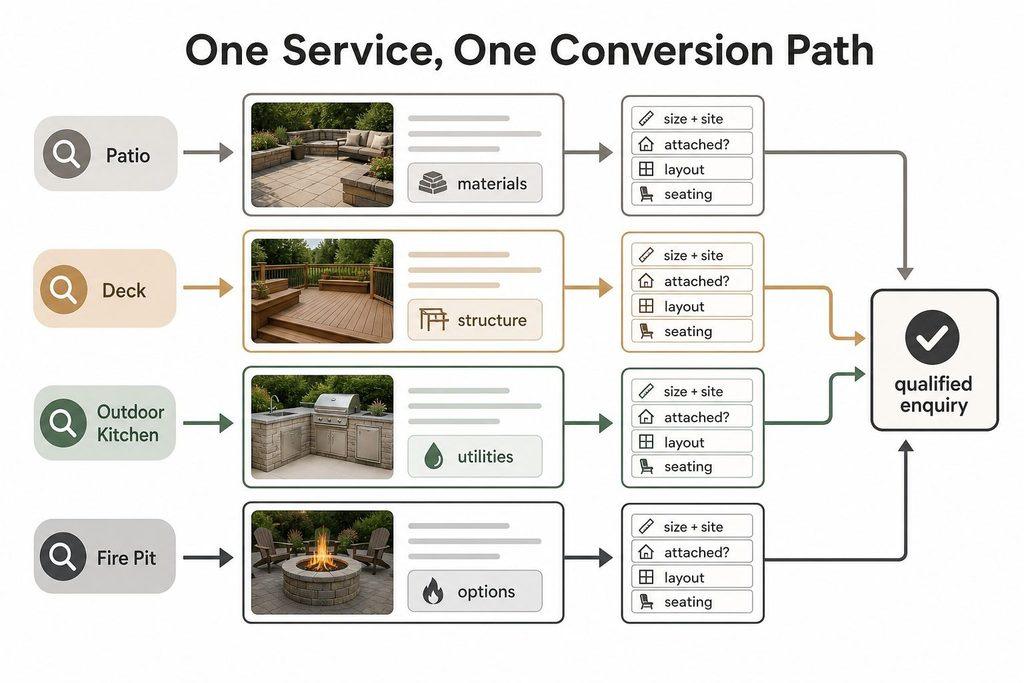
Many firms lose qualified traffic at this second stage without ever noticing, because the analytics show visits, not the quiet exit of someone who could not tell what to do next.
What a Service Page Has to Do on Its Own
Each priority service page should carry one primary intent: a patio page sells patios, not a general capability statement with patios mentioned in a list. The proof on that page, photos, project scope, materials, needs to match that single intent, and the call to action should ask for the next reasonable step toward that specific project rather than a generic “contact us.”
A page trying to serve five service types at once usually serves none of them convincingly, and a visitor comparing several contractors will notice the difference between a dedicated page and a paragraph bolted onto a broader one.
Why Mobile Experience Decides Who Stays
Responsive design is where a lot of that intent gets lost before it has a chance to convert. Outdoor living decisions are visual and often researched on a phone, in the evening, comparing several contractors’ galleries back to back.
A layout that forces pinching and zooming, project photos that load slowly, or a form that is awkward to complete on a small screen will lose a share of visitors regardless of how well the page ranks. None of this guarantees an enquiry when it is fixed. It removes a friction point that otherwise guarantees a lost one.
Enquiry forms deserve the same scrutiny. A form asking only for name and email produces contacts that still have to be manually qualified by phone before anyone knows if the project is worth pursuing.
A form that asks for rough scope, general location, and a budget range, even loosely, does some of that qualifying automatically, before a salesperson spends time on it. The commercial cost of skipping this is not a missing conversion metric. It is hours spent chasing enquiries that a shorter form would have screened out earlier.
Put Outdoor Living Margins at the Center
Service architecture should follow where the margin and the complexity actually sit, not a catalogue that lists every landscaping task the firm has ever performed under one flat structure.
A patio, a deck, an outdoor kitchen, and a fire pit are different sales conversations, with different proof requirements and different buyer expectations, and treating them as sub-bullets under “landscaping services” flattens exactly the distinction the firm needs search visibility to preserve.
Each of the following needs its own page, its own proposition, and its own evidence set, not a shared paragraph:
- Patios need a page built around material choice, drainage and grading considerations, and a photo set showing finished surfaces in different styles, with an enquiry prompt asking for approximate square footage and existing site conditions.
- Decks need proof of structural work, elevation changes, and permitting experience where relevant, with images that show framing as well as finished surfaces, and an enquiry prompt asking about attached versus freestanding structures.
- Outdoor kitchens need a page addressing utility connections, weatherproof materials, and layout planning, with images of completed builds in use, and an enquiry prompt asking about appliance preferences and covered versus open structures.
- Fire pits need a page distinguishing gas from wood-burning options and code considerations, with images showing both installed and lit, and an enquiry prompt asking about seating capacity and surrounding hardscape.
No page in that set should carry pricing or claims about regional demand that the firm cannot support with its own data. The point of separating them is specificity, not promotion.
Replace Generic Claims With Project Proof
Outdoor living work is expensive, visual, and hard to evaluate from a written description alone, which is exactly why generic claims about quality or experience do so little to move a prospect toward enquiring.
A project gallery and a well-managed review presence do the job that adjectives cannot: they let a prospect see the specific kind of outcome the firm delivers, on a project that resembles their own, before they pick up the phone.
A repeatable project page template earns its keep across dozens of jobs without becoming a fresh writing exercise each time. State the project type plainly, then the starting constraint that made it worth describing, a small backyard, a drainage problem, a tight budget for materials rather than labor.
What Belongs on Each Project Page
List the completed features in plain terms: seating wall, built-in grill, gas line, drainage system. Attach photos with descriptive context rather than bare captions, since a caption that says “before installing the paver base for the outdoor kitchen island” tells a prospect something a bare filename cannot.
Where the project location is genuinely relevant to service-area credibility, name it. Close with a next enquiry action specific to that project type, not a generic contact link.
Review management supports this without replacing it. Requesting feedback after project completion, and responding to what comes back, builds a record that reflects actual client experience over time.
It is not a ranking guarantee, and it does not substitute for the portfolio doing the harder work of showing rather than telling.
Compare the Market Without Copying It
Competitor analysis is useful for one narrow purpose here: finding observable gaps in the firm’s own coverage, not guessing at what a regional competitor’s marketing team is doing internally, which cannot be verified and should not shape strategy on assumption alone.
What can be checked is what is actually published, publicly, and compared against the firm’s own pages, profile, and enquiry process.
A working comparison checklist covers a small, verifiable set of items:
- Search visibility for each priority outdoor living service, checked individually rather than as a single landscaping category.
- Page-level project proof, meaning whether each service has its own dedicated evidence, not a shared gallery.
- Google Business Profile completeness, including category accuracy and how recently it has been updated.
- Review presentation, meaning whether reviews are recent, specific, and responded to, not simply numerous.
- Local partnership and business-association opportunities, evaluated for relevance to the trade, not pursued as generic backlink volume.
- Enquiry friction, meaning how many steps and how much information stand between a ready prospect and a submitted enquiry.
Citation building and any local backlink activity should be judged against relevance and factual accuracy alone. No directory submission or competitor-adjacent link belongs in the plan simply because it exists to be claimed.
What to Do in the Next Forty-Eight Hours
Search visibility, enquiry quality, and technical page health are three separate things, and conflating them is how a firm ends up unable to say whether a marketing spend is working.
Google Analytics shows whether traffic to priority service pages is growing and where visitors drop off before enquiring. Google Search Console shows which queries are actually surfacing those pages and whether technical issues, broken links, slow-loading pages, indexing errors, are quietly suppressing results that would otherwise show.
Neither tool alone answers the question a payer actually needs answered, which is whether the spend is producing patio and outdoor kitchen enquiries rather than lawn care calls. Together, tracked over time, they start to.
None of that measurement means anything without a verified starting point
This is the actual work of the next two days, and the order matters because each step depends on the one before it.
- First, inventory the Google Business Profile facts, name, address, phone, category, and the current state of every priority outdoor living page, patios, decks, outdoor kitchens, fire pits, listing what exists and what is missing. This comes first because every later fix depends on knowing what is actually live.
- Second, correct the single highest-risk mismatch found in that inventory, whether that is a wrong category, a page with no dedicated proof, or a form asking for nothing but an email address. Assign one person as owner of that page going forward, because unowned pages drift back out of accuracy within months. This comes second because fixing anything before the inventory is complete risks fixing the wrong thing first.
- Third, confirm Analytics and Search Console are connected and reporting, and record today’s numbers as the baseline against which every later change gets judged. This comes last because a baseline recorded before the highest-risk mismatch is fixed would only measure the mistake, not the correction.
The one thing worth doing today, before any of the rest, is compiling the business name, address, phone number, current Google Business Profile category, and a plain list of every outdoor living service page that currently exists.
Every correction that follows depends on knowing precisely what is true right now, and that inventory is the only place a staged plan can honestly begin.