

More leads are not the fix for an underbooked crew. That claim runs against most of what landscaping owners are told about marketing, but the pattern shows up constantly in reviewed campaign data: inquiry volume climbs, the phone rings more, and the booking calendar still has gaps in it.
The reason is simple once it is stated plainly. A lead is not a booking. A booking is not a profitable job. And a marketing agency paid to generate the first often has no accountability for the second or third.
What follows sets out how to structure that accountability before a contract is signed, not after the invoices start arriving.
Why Can More Leads Leave Landscaping Crews Less Predictably Booked?
A maintenance route and a hardscaping build are different products with different sales cycles, different crew requirements, and different margins. A campaign that pushes both into the same inquiry form usually produces a pile of undifferentiated leads: some are $60 mow requests, some are $40,000 patio jobs, and the office has to sort them manually while the marketing invoice treats every one as a win.
That sorting cost is real. Every hour spent qualifying a mismatched inquiry is an hour not spent scheduling a fit-for-capacity job, and every crew day left open because the pipeline is full of the wrong work is a day of fixed labor cost with no revenue against it.
Booking consistency, not lead count, is the outcome that pays the bills. A firm with fewer leads that convert at a higher rate and fill maintenance routes and hardscaping slots in the right proportion is in a stronger position than one drowning in inquiries that do not match its crew mix or its margin targets. The commercial question is never “how many leads did the campaign produce.” It is whether the calendar three weeks out looks better than it did before the spend started.
Should Marketing Stay In-House, Be Outsourced, or Go to an Agency?
The decision to hire an agency is an operating decision, not a marketing decision, and it should be evaluated the same way a hiring decision is: what does the business lose by keeping the function internal, and what does it lose by handing it out.
- Internal coordination works when someone already inside the business, often the owner or office manager, has time to manage a website, respond to inquiries same-day, and keep a modest ad account running. It fails when that person’s actual job is estimating, scheduling, or running a crew, because marketing becomes the task that gets pushed to Friday afternoon and then skipped.
- A freelance or outsourced specialist sits between the two options. Useful for a single channel and cheaper than a full agency retainer, but rarely equipped to coordinate a landing page, a lead-routing rule, and a reporting cadence at once.
- An agency partnership earns its cost under three conditions:
- the business needs more than one channel run in coordination
- nobody internal has the time or skill to manage campaign structure and reporting
- the owner is prepared to hold the agency accountable to booked-work numbers rather than activity metrics
The National Association of Landscape Professionals’ industry statistics on landscaping’s market size put the sector at $188.8 billion, a scale that argues the market is not short of demand. The harder problem is that the competition for that demand is fragmented across many small, similarly positioned firms, which is exactly the condition where a poorly scoped campaign burns budget without moving the calendar.
What Work Must Remain Inside the Business?
Nobody outside the company can set which job types are profitable enough to chase, which crews have open capacity next month, or what a qualified lead actually looks like for that specific business. Those calls stay internal regardless of who runs the campaigns.
A justified spend shows up as a schedule with fewer open days, a lead mix that matches crew capacity, and reporting the owner can tie to revenue. An unjustified one shows up as rising ad spend, rising impressions, and a calendar that looks the same as it did six months ago.
What Must Be Decided Before Asking a Landscaping Marketing Agency for a Proposal?
An agency cannot set a business’s priorities. It can only execute against priorities the business hands it, and a proposal built on vague input produces a vague scope that is difficult to hold accountable later.
Before any conversation with a prospective partner, the business needs answers to a specific set of questions:
- Which service lines are the priority for growth this season
- What geographic area is realistic to service without crew travel eating the margin
- What job size is worth pursuing versus declining
- How much maintenance capacity versus design-build capacity currently sits open
- When the seasonal slow periods land, and who inside the business owns lead response
- What the current baseline looks like for lead volume, conversion rate, and booking rate
That baseline matters more than it sounds. An agency proposal that promises “more leads” without reference to what the business converts today, and at what acquisition cost the business can actually tolerate, is not a proposal that can be measured against anything. Cost per lead and return on ad spend targets have to be set before the campaign starts, not negotiated after the first invoice arrives.
How Should a Landscaping Marketing Agency Partnership Be Structured?
A scope document is the difference between a partnership that fills a calendar and one that produces a monthly report nobody uses. Before signing anything, the business and the agency should agree, in writing, on a short set of operating terms that make later performance review possible.
The scope-setting step works best as a numbered list, because each item is a separate decision that has to be made, not a theme to discuss in the abstract:
- Define the outcome, stated as booked jobs or booked revenue by service line, not as leads or clicks.
- Name the channels that will run, and why each one matches available crew capacity rather than general visibility.
- List the deliverables, including landing pages, ad creative, and any content tied to seasonal service lines.
- Set an approval window for creative and campaign changes so nothing launches without a sign-off step.
- Write the lead-routing rule: who receives the inquiry first, and how fast a response is required.
- Fix a reporting cadence, weekly during launch and monthly once the campaign stabilizes.
- Assign account and creative ownership, including who controls the ad accounts if the relationship ends.
- Agree the reallocation rule: the specific performance threshold that triggers a shift in budget between channels or service lines.
Which Outcomes Belong in the Scope?
Booked jobs and booked revenue belong in the scope. Traffic and impressions do not, because neither one reflects whether a crew got work.
The routing rule decided in the list above should specify exactly who answers an inquiry, within what time window, and what happens if that person is unavailable. A firm evaluating a lawn care marketing agency as a point of comparison should ask how that agency structures exactly this handoff, since a campaign that generates a lead the business fails to answer within a few hours is money spent for nothing.
Which Campaign Mix Keeps Maintenance and Hardscaping Crews Booked?
Not every channel deserves budget just because it is available. The right mix depends on which crews have open capacity, which service lines carry the best margin, and which time of year the business is trying to fill.
Four recurring booking objectives cover most of what a landscaping firm actually needs from a campaign calendar, and each one calls for a different qualification signal and a different capacity condition before spend is justified.
| Booking Objective | Qualification Cue | Capacity Condition | Measurement Priority |
|---|---|---|---|
| Maintenance route continuity | Recurring service request in serviceable area | Route has open weekly or biweekly slots | Booking rate and cost per booked route |
| Hardscaping project demand | Defined project scope and realistic budget range | Design-build crew has open project weeks | Conversion rate and return on ad spend |
| Past-customer reactivation | Prior service history, lapsed within a defined window | Any crew type with near-term open capacity | Booking rate against low acquisition cost |
| Off-season demand support | Interest in services the business can deliver in slow months | Crews otherwise idle in that period | Lead volume relative to booked off-season work |
The table makes the sequencing logic visible: a hardscaping campaign run when the design-build crew is already booked for eight weeks does nothing but generate leads that sit in a queue and go cold. A reactivation campaign run against a full maintenance route wastes spend on demand the business cannot accept.
Off-season campaigns deserve particular scrutiny. They exist to keep crews working during predictable slow periods, and their success should be measured against booked work in that specific window, not against annual totals that hide the gap.
How Should the First Campaign Launch Be Run Without Losing Lead Quality?
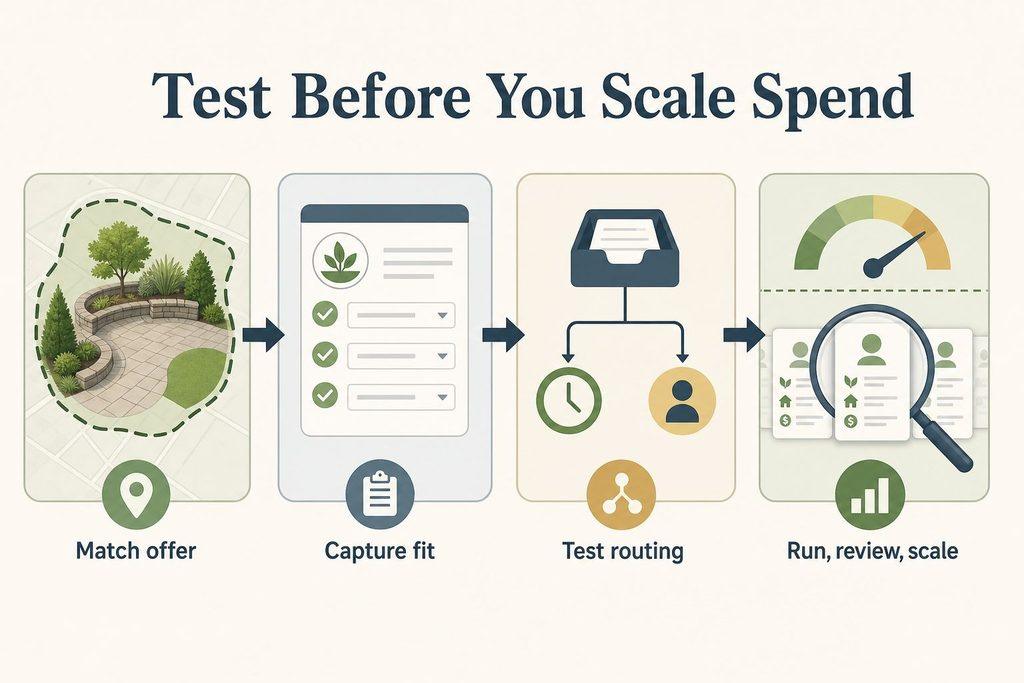
A first campaign should be treated as a contained test, not a full-scale launch, because the fastest way to lose money on a new agency relationship is to scale spend before confirming:
- the landing page,
- the inquiry form, and
- the routing process
actually work together.
The sequence runs in order.
- First, validate that the landing page offer and service-area language match what the business can actually deliver, since a page promising fast turnaround in an area the crew cannot reach in the same week creates leads that were never bookable.
- Second, agree on which fields the inquiry form captures, at minimum job type, property size, and general budget range, so unqualified requests can be filtered before they reach a scheduler’s inbox.
- Third, test the routing and confirm who owns the response before a single dollar of paid spend goes live.
- Fourth, run the campaign at a contained budget, review the early lead fit against the qualification cues already defined, and only then decide whether to adjust targeting or scale spend.
A qualified inquiry names a service the business offers, a property within the defined service area, and a job size or frequency that fits open crew capacity. Anything missing two of those three is a signal to adjust the form or the targeting before spending more.
Spend should pause when crews are fully booked for the relevant service line, when early leads are consistently below minimum job size, or when a seasonal gap the campaign was meant to fill has already closed. Continuing to spend into a full calendar produces leads with no crew to give them.
Which Numbers Show Whether the Agency Is Filling the Schedule Profitably?
A recurring performance review needs to sit on the calendar from day one, built around a fixed set of numbers rather than whatever the agency chooses to report.
The core figures are:
- lead volume
- website traffic
- conversion rate
- booking rate
- cost per lead
- return on ad spend
- booked revenue or booked capacity broken out by service line
Reviewed together, these numbers expose the mismatches that a single metric hides on its own.
Traffic rising while inquiries stay flat points to a landing page or offer problem, not a targeting problem.
Leads rising while bookings stay flat points to a lead-quality or response-time problem, often traced back to the routing rule set during scoping. Booked work rising while return on ad spend deteriorates points to a cost-per-acquisition problem that will erode margin even as the calendar looks fuller.
Every one of those figures needs to trace back to the actual channel and campaign that produced it. An agency claiming credit for a booking based on total impressions, rather than tracked leads and attributed conversions, is reporting activity, not results.
What Is the Smallest Next Step Toward a Better Agency Partnership?
The decisions above only matter once they reach a prospective or existing agency in a form specific enough to produce a comparable answer. That happens today, in a single message, not after another round of internal debate about priorities.
The request should state:
- the crew type and service area at stake
- the job size that qualifies as a priority
- the current baseline for lead and booking performance (or an honest admission that no baseline exists yet)
- the reporting terms expected in return
Sending that message today, to one agency or to the incumbent, converts everything decided so far into something that can be evaluated on paper rather than debated in the abstract.
Whatever comes back in response is the first real test of the partnership, long before the first campaign goes live: an agency that answers each line specifically is showing how it will report later, and one that answers only in general marketing language is showing that too.
Copy the lines below, fill the brackets, and send them as the opening message to a prospective agency or an existing partner:
“We need to keep [maintenance/hardscaping] crews booked in [service area].” “Our priority jobs are [job type and minimum value].” “Our current lead, conversion, and booking baseline is [figures or unknown].” “Please propose the channels, lead-routing process, and reporting cadence.” “Show how success will be measured through booked work, cost per lead, and return on ad spend.”