

The agency with the most architecture photography in its portfolio is not necessarily the one that gets a firm shortlisted. That claim runs against the instinct that governs most vendor selection in the profession, where visual fluency in the built environment stands in for proof of commercial results. It is a reasonable instinct and a poor decision rule.
Photography of finished buildings tells an evaluator that an agency can make a project look good after the fact. It says nothing about whether that agency can move a firm through a pursuit, shorten a sales cycle, or convert visibility into signed contracts.
The distinction matters because the cost of a wrong agency choice in this category is not a wasted invoice. It is a missed shortlist, a stalled pipeline, and a marketing budget spent building a brand nobody outside the firm ever evaluates against a business outcome. What follows treats agency selection as a set of checks that can be verified, in order of what breaks first when skipped.
Why Is Architecture Marketing Not a Generalist Assignment?
Marketing a design-led practice runs on different mechanics than marketing most consumer or B2B businesses. Reputation and referral still drive a large share of new work, built projects function as the only durable proof of capability, and the buying cycle for a signature residence or a mixed-use development can stretch across many months of relationship-building before a request for qualifications ever appears.
A generalist agency built around paid acquisition funnels and rapid conversion testing is optimizing for a sales motion that barely exists in this market.
The SMPS 2024 State of AEC Marketing Report was highlighted as a resource for architecture, engineering, and construction marketing professionals, and its relevance here is structural rather than statistical: it frames marketing performance in this sector around pipeline and pursuit outcomes, not the traffic-and-impressions metrics that dominate generalist reporting.
Two further constraints shape any evaluation. The AIA Code of Ethics sets professional conduct expectations that bear on how a firm’s work and credentials get represented publicly, and local advertising regulations vary by jurisdiction in ways that affect claims, certifications, and licensure language in marketing materials. Neither is a marketing skill. Both are evaluation context an agency needs to operate inside without creating exposure for the firm that hires it.
What Must an Architect Marketing Agency Be Able to Deliver?
Before comparing agencies on quality, an evaluator needs a fixed list of what is actually in scope. Service breadth varies enormously between vendors calling themselves architecture marketers, and an unclear scope is how firms end up paying twice, once for a service they assumed was included and once for the agency that actually delivers it.
A working architect marketing agency should be able to document capability across five areas, and each one should be checkable as present or absent in the proposal, not implied by a portfolio page:
- Positioning and brand systems: a defined market position, visual identity, and messaging framework tied to the firm’s actual project types.
- Portfolio and case-study development: a repeatable process for turning completed projects into sales-usable evidence, not a one-off photo shoot.
- Website, SEO, and content: technical ownership of the firm’s site, organic visibility strategy, and a content plan connected to search behavior.
- Lead generation: defined channels and a stated mechanism for how inquiries reach the firm, not a promise of “increased visibility.”
- Pursuit and proposal support: direct involvement in shortlist submissions, not marketing collateral produced in isolation from active pursuits.
Each of these five items should map to a stated business goal in writing. An agency that cannot produce that map on request is asking the firm to trust intent rather than verify scope.
How Should an Architecture Firm Score a Marketing Agency?
A reputation check is not a scoring method. It produces a ranked impression, not a comparable record, and it cannot be shown to a partner group as the basis for a six-figure commitment. A ten-criterion, twenty-point evaluation, with two points available per criterion, gives an evaluator something closer to that: a structure where each check resolves to yes or no, and the total is defensible after the fact.
What Proves Strategic Fit?
Strategic fit covers whether the agency’s specialization matches the firm’s actual market. The first check is direct: does the agency work primarily with architecture and design firms, or is architecture one vertical among many unrelated ones? The second checks relevance of scale and sector, specifically whether the agency has produced work for high-end residential and commercial development clients comparable to the pursuits the firm is chasing, rather than adjacent categories like general contractors or interior retail brands.
What Counts as Specialist Proof?
Proof beyond a client list means named, verifiable case studies the firm can review in detail, not logos on a page. This is where a generalist portfolio and a specialist one diverge sharply: a case study built for a boutique residential commission reads differently, and needs to read differently, than one built for a developer pursuing institutional capital. An evaluator should be able to request three comparable case studies and receive them without delay.
What Proves Delivery Capacity?
Delivery capacity covers team access (does the firm reach dedicated staff or a rotating account pool), process clarity (is there a documented workflow with named approval points), and technology fit (does the agency’s stack integrate with the firm’s existing CRM and content systems without a forced platform migration).
What Proves Commercial Accountability?
The final group covers pricing clarity, measurement discipline, and conflict or scope fit, meaning whether the agency already represents a competing firm in the same market and whether its minimum engagement size matches the firm’s budget reality.
One caution belongs here: a vendor’s self-published score against its own scorecard is marketing copy, not independent evidence, regardless of how the criteria are framed. An evaluation is only as good as who is holding the pen.
Which Case Studies Prove Fit for the Contracts at Stake?
A polished case study and a useful one are not the same document. A 2026 guide for architecture firms recommends structuring project case studies around six fixed elements, and that structure is worth adopting as an evaluation checklist regardless of who wrote it, because it forces a case study to prove something rather than simply display something.
Before accepting a case study as evidence of fit, confirm it includes:
- Project overview: scope, project type, and market segment stated plainly.
- Challenge: the actual business or positioning problem, not a generic description of the building.
- Approach: what the agency specifically did, distinct from what the firm’s own architects did.
- Outcome: a stated result, ideally tied to a pipeline or pursuit metric.
- Services: which of the agency’s offerings were involved.
- Next step: what happened after delivery, a signal of an ongoing relationship rather than a single transaction.
The harder test is whether the outcome connects to a shortlist opportunity, a qualified lead, or a signed contract, rather than resting on award recognition or attractive photography alone. A case study built around a beautifully documented single-family residence is not automatically evidence that the same agency can support a developer pursuing a mixed-use RFQ. Neither category is inherently disqualifying. The evaluator’s job is to check whether the evidence on offer actually resembles the contract at stake.
Can the Agency Strengthen Proposals, Pursuits, and Capture?
Marketing capability and business-development capability are frequently sold as one service and delivered as two disconnected ones. A firm evaluating an agency for high-value pursuits needs proof that sector expertise translates into pursuit work specifically, not brand assets that arrive after a shortlist decision has already been lost.
The checks here follow the pursuit lifecycle itself, and each stage has its own failure mode if the agency is only assembling generic materials.
Qualification and shortlist stages
During qualification, can the agency help assess whether a pursuit is worth the investment, based on fit rather than availability of staff hours? During shortlist progression, does the agency contribute to project selection and credentials packaging tailored to the specific opportunity, rather than reusing a generic capabilities deck?
Proposal and interview stages
At proposal submission, does the agency produce or substantially shape the written and visual materials, with a stated turnaround against the RFQ deadline? At the interview stage, is there support for presentation coaching or visual assets, and is that support documented as a deliverable rather than assumed?
Ownership and approval points need to be written down before the engagement starts. An agency that cannot name who signs off on a proposal draft, or how many review rounds are included, is not ready to be trusted with a deadline that cannot move.
When Does Agency, In-House, or Hybrid Delivery Make Sense?
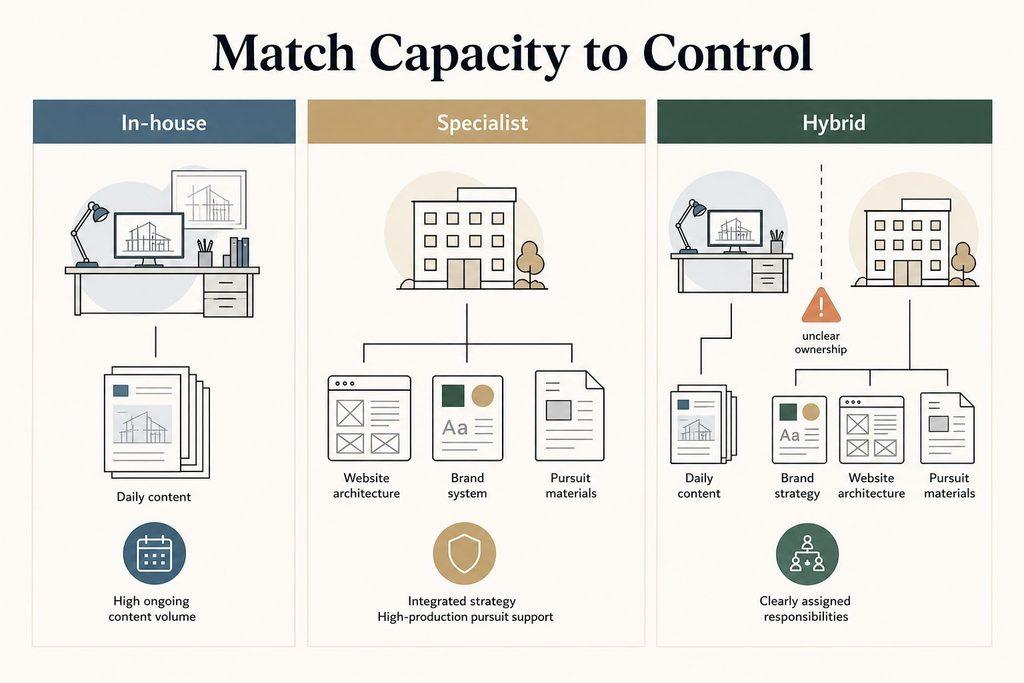
Choosing the wrong delivery model costs more than choosing the wrong vendor within the right one, because it is harder to reverse mid-cycle. A firm that builds an internal team for work requiring a full production and strategy bench will discover the gap only when a pursuit deadline exposes it. A firm that outsources everything to a specialist agency while lacking any internal marketing judgment will struggle to evaluate whether the work being delivered is actually good.
- An in-house team makes sense when production volume is high, brand judgment needs to live inside daily project decisions, and the firm has the budget to staff strategy, design, and content roles rather than one generalist marketing hire wearing all three hats.
- A specialist agency makes sense when internal capacity is limited, the firm needs integrated execution across strategy, web, content, and pursuit support without managing multiple vendors, and specific pursuits demand production quality the internal team cannot match on its own timeline.
- A hybrid model works only when responsibilities are explicitly divided in writing, such as an internal marketer owning day-to-day content and client relationships while an outside specialist owns brand strategy, website architecture, and pursuit materials. Ambiguity about who owns what is the single most common failure mode inside hybrid arrangements, not the division of labor itself.
What Should Pricing, Contract Terms, and Measurement Reveal?
Price comparisons that stop at the monthly retainer figure miss the terms that actually determine value. A lower fee attached to undefined deliverables and unclear ownership rights is not a discount. It is deferred cost.
What Should the Scope Actually Cover?
The proposal should state, in writing, what is included and what is explicitly excluded, down to the level of who produces photography, who writes proposal copy, and whether pursuit support is billed separately from ongoing brand and content work. A scope document with vague boundaries is the most common source of mid-engagement disputes, because it lets either party redefine “included” after the invoice arrives.
What Do the Fee and Exit Terms Actually Say?
Fee structure, change control process, content and design ownership, and exit terms need equal scrutiny. Who owns the website code and design files if the relationship ends. What happens when a pursuit requires work outside the retained scope, and at what rate. These terms rarely get negotiated up front and almost always matter later.
How Often Should Reporting Actually Happen?
Reporting cadence and data access determine whether the firm can verify performance independently rather than relying on the agency’s own summary. A firm should have direct access to analytics platforms and CRM data, not a monthly PDF built entirely from the agency’s chosen framing.
What Should Get Measured, and Against What Baseline?
Every metric under discussion needs a stated baseline and a clear definition before the engagement starts. That list should include qualified leads, conversion rate from inquiry to proposal, client acquisition cost, website traffic broken down by source, brand awareness where it can be reasonably estimated, and return on investment calculated against actual fees paid.
Website traffic and awareness are leading indicators, useful for tracking momentum, but they are not the outcome the firm is paying for. Contract acquisition is the outcome. A reporting package that leads with traffic growth and buries pipeline and win-rate data at the bottom is measuring the wrong thing on purpose.
Which Agency Choice Fits the Evidence?
Score the leading two candidates against the same ten criteria today, using the same evidence standard for both: named case studies, documented scope, and written pricing terms, not a sales conversation. Whichever option scores higher on the highest-consequence criteria, specialist proof and pursuit capability among them, is the one to proceed with, regardless of which one produced the more polished pitch deck.
| Situation on the Ground | Right Choice |
|---|---|
| Limited internal marketing staff, active pursuits needing full production support | Specialist agency with documented development-sector case studies |
| High content volume, brand judgment needed inside daily project decisions | In-house team with dedicated strategy and design roles |
| Internal marketer exists but lacks pursuit or web-strategy depth | Hybrid model with responsibilities assigned in writing |
| No verifiable case studies matching the firm’s project scale | Continue evaluation, do not commit budget yet |
| Vendor scope excludes proposal and pursuit support entirely | Reject regardless of price, scope does not match the stated need |
The evaluation only holds up if it gets used before the next contract decision, not after the pitch has already created a preference the scorecard is asked to confirm.